
What is zkPass and Why is It Important for Web3 Privacy?
The internet was built on visibility, not verifiability. For years, we've shared data online without any real way to prove that data is authentic. Screenshots can be faked. Credentials can be fabricated. And most of the time, trust comes down to assumption rather than actual proof. This gap between what we can see and what we can verify has created major problems across industries like finance, healthcare, and identity management.
zkPass is a decentralized oracle protocol designed to solve this exact problem. It uses something called the zkTLS protocol to turn private Web2 data into cryptographic proofs. These proofs are portable, privacy-preserving, and verifiable across different networks. The key innovation here is that zkPass lets users prove facts from any HTTPS website without needing trusted intermediaries, OAuth integrations, or API keys. This means you can verify data from traditional websites in a way that works seamlessly with blockchain applications.
The protocol runs on what the team calls a "Credibility Flywheel." Web2 and Web3 data flows through privacy-preserving verification, which creates utility. That utility drives adoption, and adoption attracts validators and network participants. As more people join, the network becomes more valuable, which leads to more integrations. It's a self-reinforcing cycle designed to build a trust economy for the digital world.
Why Traditional Data Verification Fails on Privacy
Traditional data verification has a fundamental flaw. When a Verifier needs to check information about a Prover, they usually get full access to the Prover's private data from the DataSource. This creates a significant risk of data leakage because the Verifier sees everything, not just the specific fact they need to confirm.
Think about it this way. If you need to prove you're over 18 to access a service, the current system often requires you to show your entire ID document. The verifier doesn't just learn your age—they also see your address, your full name, your ID number, and other sensitive details. This approach puts users in an uncomfortable position where they must sacrifice privacy for verification.
zkPass changes this dynamic completely. Instead of giving the Verifier access to raw data, the protocol lets users generate cryptographic proofs that confirm specific facts without revealing underlying information. The Verifier gets the confirmation they need, but they never see the actual data. This is what makes zkPass a game-changer for privacy-preserving verification.
How zkTLS Works: Verifying Web2 Data Without Leaks
The zkTLS protocol takes a different approach to data verification by repositioning who controls the flow of information. In traditional systems, the Verifier acts as an intermediary between the Prover and the DataSource. With zkPass, the Prover sits between the Verifier and the DataSource instead. This small architectural change has big implications for privacy.
Here's how the process works. The Prover uses their own access token to retrieve data directly from the DataSource. They then generate a Zero-Knowledge Proof based on that data. The Verifier can check this proof to confirm the fact is true, but they never see the Prover's personal information. The entire verification happens without exposing sensitive data.
The protocol is built using three core cryptographic technologies:
- Three-Party TLS (3P-TLS): This extends standard TLS encryption to support three participants in a secure communication
- Multi-Party Computation (MPC): This allows multiple parties to jointly compute functions without revealing their individual inputs
- Non-Interactive Zero Knowledge (NIZK): This enables proofs to be verified without back-and-forth communication between prover and verifier
Speed is another important factor. The protocol uses the VOLE-in-the-Head algorithm, which allows proof generation at millisecond speeds directly on local devices. Users don't need special hardware or cloud services to create proofs.
The ticker is $ZKP, source: zkPass
Hybrid Mode Explained: How zkPass Works on Any HTTPS Site
zkPass operates in what the team calls Hybrid Mode. This combines two different approaches to handle various network conditions and server restrictions. The flexibility matters because not all websites and servers behave the same way.
Proxy Mode is the default operating mode. The Prover communicates with the DataSource through the Verifier, which acts as a proxy. This approach is efficient and works well in most situations. However, some TLS servers block requests from the same account when they come from different IP addresses. That's where MPC Mode comes in.
In MPC Mode, both the Prover and Verifier act as separate clients communicating with the DataSource. This bypasses restrictions that would otherwise block verification attempts. By supporting both modes, zkPass can work with virtually any HTTPS website regardless of how their servers are configured.
What Makes zkPass Different From Other ZK Verification Protocols
zkPass introduces several advantages that set it apart from existing verification methods. These features address common pain points in the data verification space.
| Feature | What It Means |
| Privacy-Preserving | Sensitive user data never leaves the device |
| Universal Compatibility | Works with any HTTPS website without OAuth or custom integrations |
| Anti-Cheating | Template-based verification prevents manipulation of requests and responses |
| Trustless Attestations | Decentralized MPC nodes verify data integrity before proofs are accepted |
The universal compatibility aspect deserves extra attention. Most verification solutions require websites to implement specific APIs or OAuth flows. This creates friction because not every website supports these integrations. zkPass sidesteps this problem entirely by working with standard HTTPS connections. If a website uses HTTPS, zkPass can verify data from it.
The anti-cheating feature is also noteworthy for advanced users. Template-based verification ensures that neither the client requests nor the server responses can be manipulated. This prevents users from falsifying credentials or achievements, which is especially important for applications like airdrops or credential verification.
Who Founded zkPass? Team and Background Explained
Two co-founders lead zkPass development. Bing Jiang serves as Co-Founder and CTO, handling the technical architecture. Joshua Peng is Co-Founder and focuses on strategic growth and public-facing activities. Peng notably won Binance's "Build The Block" competition, which helped put zkPass on the map within the crypto ecosystem.
Both founders share a focus on building zero-knowledge data verification infrastructure for Web3. Their combined technical and business expertise has helped the project secure significant funding and partnerships.
zkPass Funding and Investors: Who is Backing the Protocol
zkPass has raised substantial capital across two funding rounds, reaching a valuation of $100 million.
| Round | Date | Amount Raised | Valuation |
| Seed Round | August 3, 2023 | $2.5 million | Not disclosed |
| Series A | October 17, 2024 | $12.5 million | $100 million |
The seed round included participation in the Binance Labs incubation program. Key investors across both rounds include dao5, CE Innovation Capital, Animoca Brands, Flow Traders, Bing Ventures, and IOBC Capital. The backing from established crypto investment firms signals confidence in the protocol's technical approach and market potential.
ZKP Token Explained: Utility, Supply, and Tokenomics
$ZKP is the native utility token of the zkPass ecosystem. It serves as the functional medium for settlement, verification, and protocol participation. The token follows the ERC-20 standard and has a fixed total supply of 1 billion tokens with no inflation mechanism.
The tokenomics include a deflationary component. A portion of settlement fees gets burned, which reduces the circulating supply over time. There's also a DAO-led buyback mechanism funded by protocol revenue. These periodic buybacks add additional buying pressure while supporting the token's long-term value.
The $ZKP token has five main utility functions:
- Settlement Medium: All proof settlement and verifier execution within zkPass requires $ZKP
- Validator Collateral: Validators must stake $ZKP as collateral to ensure network reliability and uptime
- Network Credits: The token acts as on-chain credits for recording network contributions like verifiable computation
- Service Access: Enterprises and developers pay $ZKP to access verification APIs and privacy infrastructure
- Governance & Coordination: Token holders participate in decentralized decision-making and protocol maintenance
Token Allocation and Vesting Schedule
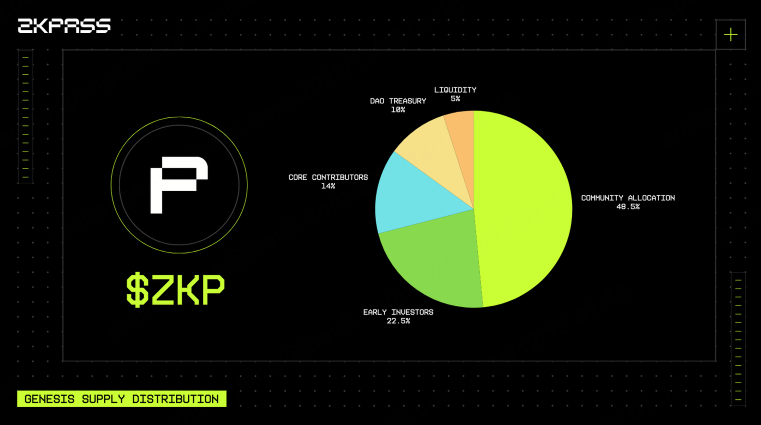
$ZKP token allocation, source: zkPass
The largest portion of the supply, 48.5%, is allocated to the community. This includes a 12.5% unlock at the Token Generation Event (TGE), followed by linear vesting. Early investors hold 22.5% of the supply, but they face a 12-month cliff before they can access any tokens. Core contributors have an even longer wait, with a 24-month cliff. The DAO Treasury holds 10% for future needs, and 5% is allocated to liquidity to ensure smooth trading at launch.
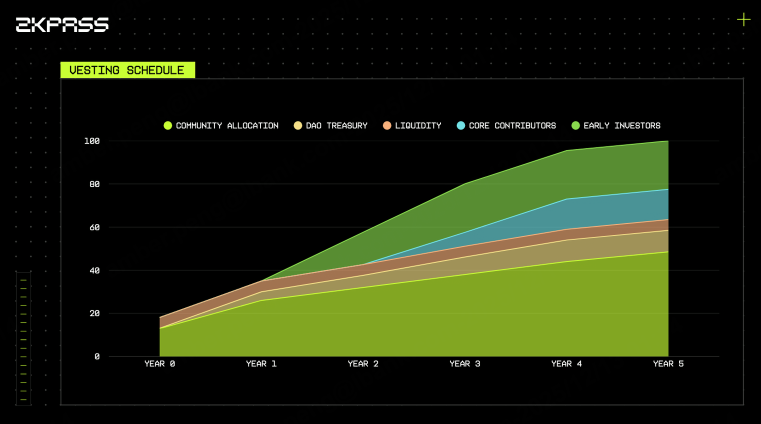
$ZKP vesting schedule, source: zkPass
The distribution of the $ZKP token is designed to prioritize long-term stability over short-term gains. A notable feature of the vesting schedule is that the team and early investors have 0% of their tokens unlocked at the launch event. This aligns their incentives with the long-term success of the protocol.
zkPass Roadmap: Key Milestones and 2025 Timeline
Real-World Applications and Use Cases
zkPass proofs can work across multiple data domains. These include legal identity verification, financial records, healthcare information, social and behavioral data, and professional or educational credentials. The protocol's flexibility makes it suitable for various industries with different verification needs.
The strategic impact of zkPass creates different benefits for different stakeholders:
- For individuals: Users gain sovereignty over their personal and professional data by choosing exactly what gets disclosed and where
- For enterprises: Organizations reduce liability, improve compliance efficiency, and get guaranteed assurance of data authenticity
- For ecosystems: New application categories become possible, especially in regulated domains where trust and privacy traditionally conflict
Integration possibilities span AI applications, DePIN projects, digital identity systems, DeFi lending protocols, governance mechanisms, and compliance solutions. Each of these areas benefits from verification that doesn't compromise user privacy.
Why zkPass Could Become Core Web3 Privacy Infrastructure
zkPass positions itself as the universal verification layer for the digital era. By replacing raw data disclosure with cryptographic attestations, the protocol fundamentally changes how verification works online. Users no longer need to choose between proving something and protecting their privacy.
The Credibility Flywheel mechanism is designed to compound utility and credibility across the ecosystem. As more applications integrate zkPass, more data becomes verifiable. As more data becomes verifiable, more applications find value in integrating zkPass. This cycle creates network effects that could make zkPass a foundational layer for Web3 identity and verification.
For advanced users and developers, zkPass represents infrastructure that enables applications which simply weren't possible before. Sybil-resistant systems, privacy-preserving credit scoring, and cross-platform credential portability all become achievable without centralized intermediaries. The protocol serves as a coordination layer for any system that requires proof before action, making it a potentially critical piece of Web3 infrastructure.