

What is Monad? Understanding the Parallel EVM Layer 1
Monad is a monolithic Layer 1 blockchain designed for scalable decentralized applications and smart contracts. The project aims to resolve what developers call the "EVM Bottleneck." This refers to the congestion, high fees, and slow finality that result from sequential execution models on networks like Ethereum.
The network delivers 10,000 transactions per second with 1-second block times and single-slot finality. These performance metrics put Monad in competition with high-speed chains like Solana and Aptos. But Monad offers something those networks cannot. It maintains full compatibility with existing Ethereum developer tools and smart contracts.
Think of traditional blockchains like a single-lane laundry room where you must wash, dry, and fold one load completely before starting the next. Monad is like a commercial-grade laundromat that uses pipelining. While one load is in the dryer, the next is already in the washer. By adding parallel lanes and a smart manager to handle the flow, the facility processes hundreds of loads simultaneously without anyone waiting.
Unlike Layer 2 solutions that rely on centralized sequencers, Monad provides this performance while maintaining decentralization on a unified chain. This approach appeals to developers who want Ethereum compatibility without sacrificing speed or paying high gas fees.
Who Founded Monad and How the Team is Structured
Monad was co-founded by experts with backgrounds in high-frequency trading and quantitative finance. The founding team came from Jump Trading, one of the largest proprietary trading firms in the world. This background heavily influences the project's focus on speed and efficiency.
Keone Hon serves as CEO. He applies his experience building HFT systems to create a faster EVM. High-frequency trading requires processing massive volumes of data in milliseconds. Hon brought this expertise to blockchain architecture.
Eunice Giarta is the COO. Her background spans product development and fintech. She drives business operations and ecosystem growth for the project.
James Hunsaker was a co-founder and technical lead. He now serves as CEO of Category Labs, which emerged from a strategic organizational split in late 2024.
The project underwent restructuring to foster independent growth. The Monad Foundation now operates as an independent organization dedicated to validator-led governance, community improvement proposals, and ecosystem development. Category Labs, formerly known as Monad Labs, focuses on software development and research for the underlying protocol.
Inside Monad's Launch With Co-founder Eunice Giarta
Monad Funding History and Institutional Backing
Monad has raised a total of $244 million across two primary funding rounds. This substantial capital provides resources for development and ecosystem growth.
The seed round closed on February 14, 2023. Dragonfly led the round, which raised $19 million. This early funding allowed the team to build out the core technology and prove the concept.
The Series A round completed on April 9, 2024. Paradigm led this massive $225 million raise. Participants included Amber Group, Coinbase Ventures, and Greenoaks. The size of this round signaled strong institutional confidence in Monad's technical approach.
The backing from top-tier crypto venture firms validates the project's ambitious goals. Paradigm and Dragonfly are among the most respected investors in the space. Their due diligence provides some assurance about the team's capabilities and the technology's viability.
How Monad Blockchain Works: Parallel EVM Execution
Monad achieves its performance through custom-built layers across the entire blockchain stack. The core innovation is called optimistic parallel execution.
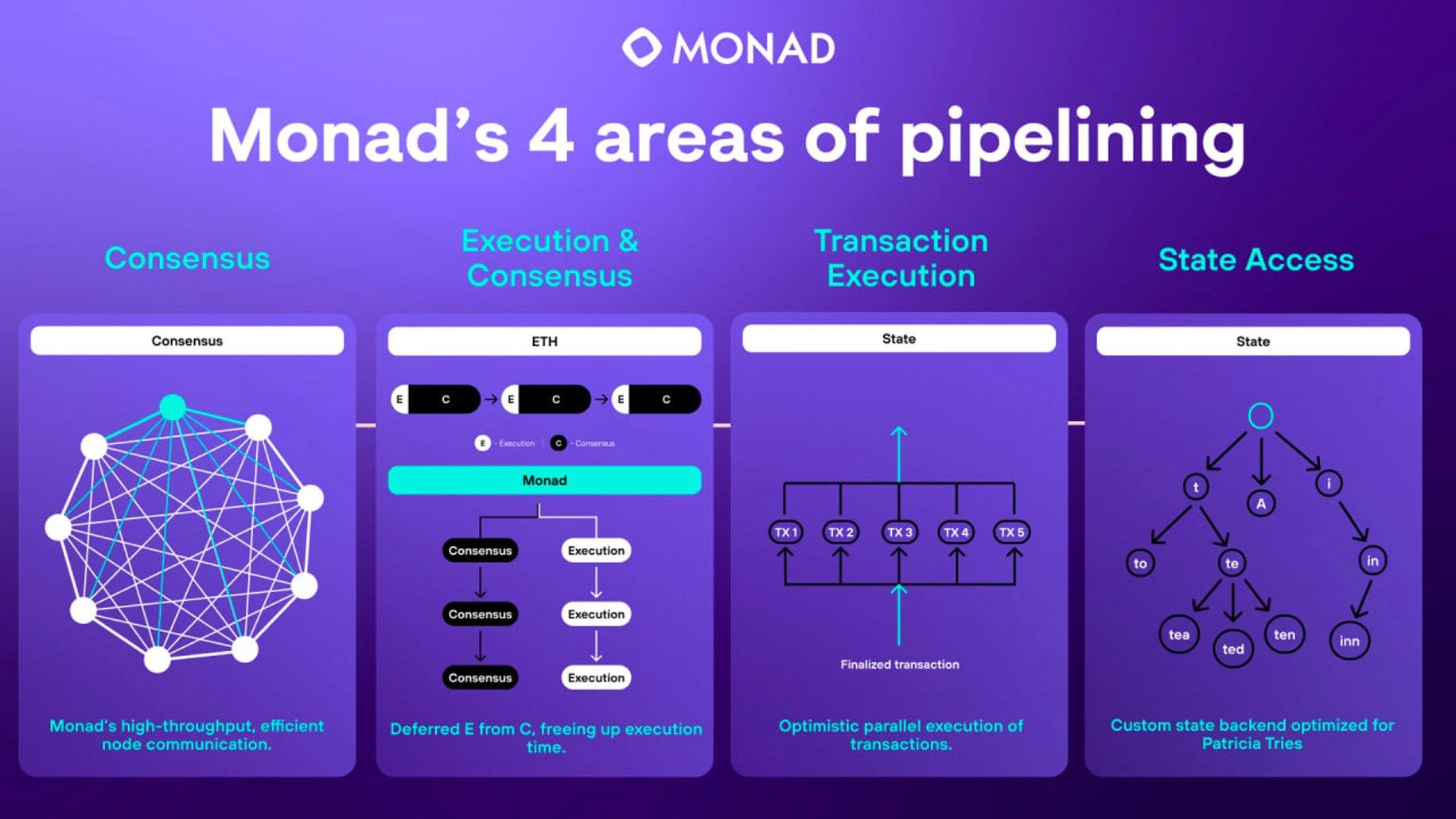
Parallel EVM execution, image source: Monad
Traditional EVM chains process transactions sequentially. Each transaction must complete before the next one starts. This creates a bottleneck that limits throughput regardless of how powerful the hardware becomes.
Monad takes a different approach. The system assumes most transactions are independent and executes them simultaneously across multiple CPU cores. If a conflict is detected, only the conflicting transactions are re-executed. This optimistic approach works because most transactions in practice don't actually conflict with each other.
Asynchronous execution is another key innovation. This decouples transaction execution from the consensus process. Slow or complex transactions don't delay the production of new blocks. The network can keep moving forward while complex computations finish in the background.
Directed forwarding eliminates the traditional global mempool. Instead, RPC nodes maintain local mempools and forward transactions directly to upcoming block leaders. This reduces bandwidth consumption and speeds up transaction propagation across the network.
Monad Architecture Explained: MonadBFT Consensus and MonadDB
MonadBFT is Monad's custom consensus mechanism derived from the HotStuff protocol. It achieves speculative finality in one slot, which takes approximately 400 milliseconds. Full finality arrives in two slots at around 800 milliseconds. This speed matches or exceeds competitors while maintaining Byzantine fault tolerance.
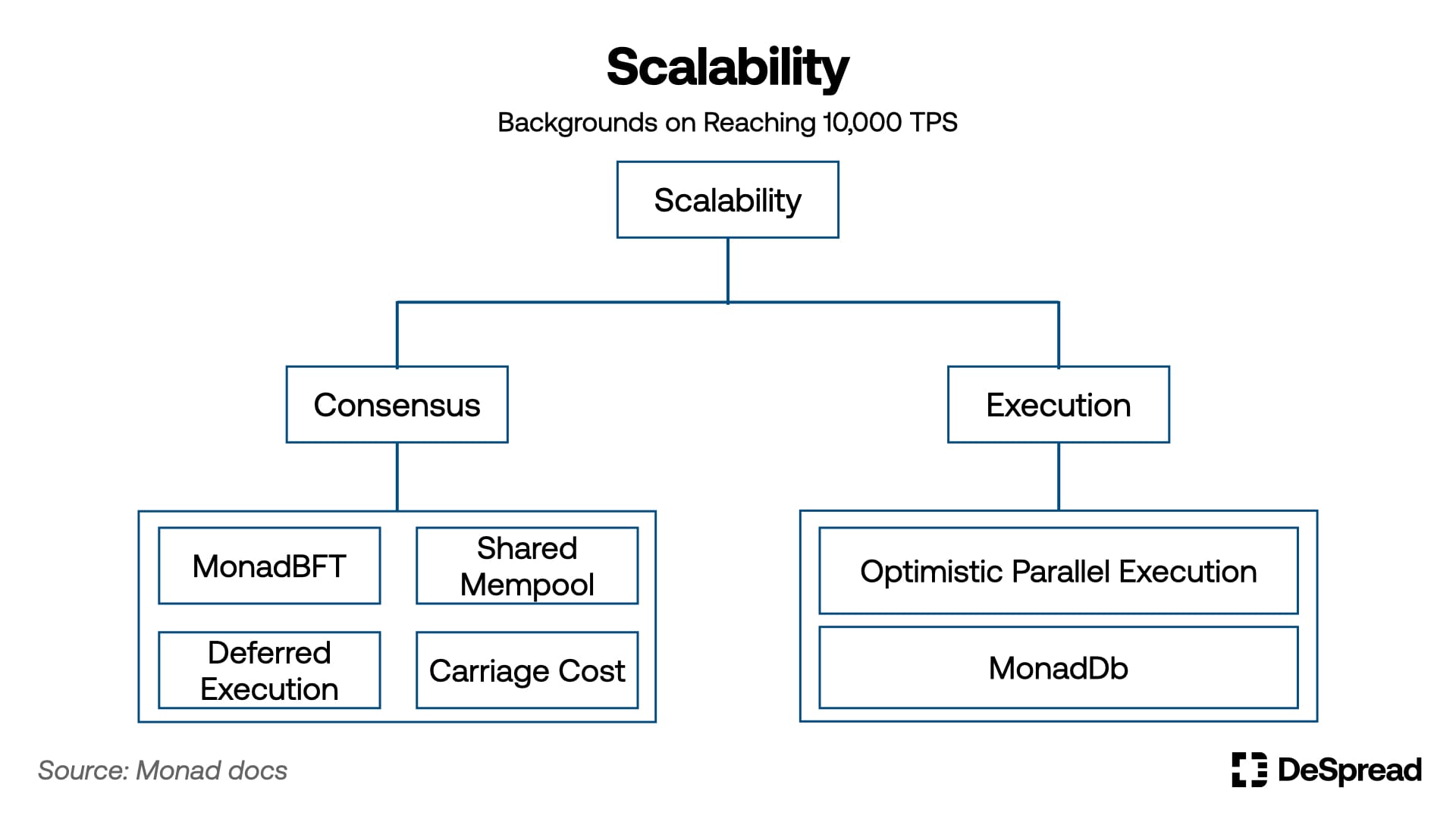
Monad Technical Architecture, image source: Monad, DeSpread
MonadDB is a specialized state database engineered to handle the Merkle Patricia Trie efficiently. The Merkle Patricia Trie is the data structure Ethereum uses to store account states. It's notoriously difficult to optimize for parallel access.
Key MonadDB features:
- Allows parallel threads to access state simultaneously
- Stores most data on SSDs rather than expensive RAM
- Lowers hardware barriers for validators
- Enables efficient state management at high throughput
The SSD optimization is particularly important. Running an Ethereum node requires substantial RAM because the state database needs fast access. MonadDB's design lets validators use cheaper hardware configurations. This lowers the barrier to running a validator and improves decentralization potential.
Monad vs. MegaETH and Other High-Performance Blockchains

Against Solana and Aptos, Monad matches or exceeds their speed benchmarks while offering full EVM compatibility. Developers can migrate existing Ethereum applications without rewriting code. This compatibility significantly reduces friction for teams considering a move.
Against Layer 2 solutions, Monad provides composability and real-time censorship resistance as a base layer. L2s rely on underlying chains for security and cannot always guarantee these properties. The tradeoff is that L2s can potentially achieve higher throughput by inheriting security from Ethereum.
MegaETH targets even higher throughput at 100,000+ TPS with millisecond block times. But it operates as a rollup rather than an independent L1. Monad's monolithic approach means all execution happens on a single unified chain without relying on external data availability layers.
MON Tokenomics, Utility, and Governance Model
The MON coin serves as the native utility and governance token for the Monad network. It plays multiple roles in the ecosystem.
Transaction fees are paid in MON. The network implements a burn mechanism similar to Ethereum's EIP-1559. A portion of each transaction fee is permanently destroyed. This creates deflationary pressure as network usage increases.
Staking secures the network through proof-of-stake consensus. Validators must stake MON to participate in block production. Delegators can stake with validators to earn rewards.
Governance operates through the Monad DAO. Token holders can vote on protocol changes and ecosystem initiatives. The Monad Foundation coordinates governance activities and community improvement proposals.
The tokenomics design aligns with standard proof-of-stake models. Stakers earn rewards for securing the network. The burn mechanism creates scarcity as adoption grows. Governance rights give holders influence over protocol direction.
Monad Blockchain Timeline and Major Milestones
Monad Token Sale Overview and Market Response
Despite the strong technology and funding, the project has faced market challenges. The public token sale on Coinbase raised $43 million in 23 minutes, which sounds impressive. However, demand slowed significantly after the initial rush. Over 50% of the allocated supply remained unsold after 6 hours.
The response was considered modest compared to competitors. MegaETH (MEGA) token sale generated more sustained demand throughout its duration. This comparison highlighted that Monad faces stiff competition in the high-performance blockchain category.
Several factors may explain the slowdown. Market conditions affect all token sales. Competition from other launches divides available capital. Some investors may prefer waiting for secondary market trading rather than participating in primary sales.
The sale still raised substantial capital for ecosystem development. $43 million provides meaningful resources for grants, partnerships, and growth initiatives. But the demand pattern suggests Monad must continue proving its value proposition to attract broader participation. This tepid public sale response highlights the competitive nature of the Layer 1 market. Investors are becoming more selective, and high-throughput claims alone may no longer guarantee instant market dominance.
Monad Ecosystem Growth and Key Integrations
The ecosystem has grown through strategic integrations and developer programs. These partnerships demonstrate real-world adoption of Monad's technology.
Rubic facilitated 17.8 million transactions in just three days after integration. This volume demonstrates the network can handle substantial throughput in production conditions. Cross-chain bridge activity often generates high transaction counts.
Biconomy integration enables gasless transactions. Users can interact with applications without holding MON for fees. This improves user experience and lowers barriers to adoption for new users unfamiliar with managing gas.
Alchemy Pay adds fiat on-ramp capabilities. Users can purchase MON directly with traditional payment methods. This integration makes the ecosystem more accessible to mainstream users.
AI Blueprint is a program supporting teams building AI applications on Monad. The initiative provides infrastructure and operational support. AI-focused applications often require high throughput for real-time processing, making Monad's architecture well-suited for these use cases.
The diversity of integrations shows ecosystem breadth. From cross-chain bridges to payment infrastructure to AI applications, Monad is attracting projects across multiple categories. This variety reduces dependency on any single use case for network activity.
Evaluating Monad Blockchain: Strengths, Risks, and Tradeoffs
Evaluating Monad requires balancing its technical achievements against market and execution risks. The project offers genuine innovation but faces significant competition.
Potential strengths:
- Full EVM compatibility reduces migration friction for developers
- 10,000 TPS with sub-second finality matches top competitors
- $244 million in funding from top-tier investors like Paradigm
- Experienced team from high-frequency trading background
- MonadDB design lowers hardware requirements for validators
- Growing ecosystem with real transaction volume
Significant concerns:
- Token sale showed demand slowdown after initial surge
- MegaETH and other competitors target even higher throughput
- Mainnet just launched in November 2025, limited track record
- High-performance L1 space is increasingly crowded
- Must compete with established networks like Solana
- EVM compatibility alone may not differentiate long-term
The technical architecture genuinely solves real problems. Parallel execution and asynchronous consensus represent meaningful innovations. The HFT background of the founding team brings relevant expertise to building fast systems.
The competition is intense. Solana already has established network effects and ecosystem. MegaETH claims 10x higher throughput than Monad. Ethereum L2s continue improving and benefit from Ethereum's security. Monad must carve out its position in a crowded market.
The EVM compatibility is a strategic advantage for initial adoption. Developers can deploy existing code without modifications. But as the ecosystem matures, native applications built specifically for Monad's capabilities may matter more than compatibility.
For advanced investors, Monad represents exposure to the high-performance L1 thesis. The project has strong funding, capable team, and legitimate technology. But the modest token sale response suggests the market is not yet fully convinced. Position sizing should reflect both the opportunity and the execution risk still ahead.