
What Ocean Protocol Is and the Problem It Solves
The modern AI economy runs on data. The companies training the most powerful models are the ones that already control the largest datasets, and they extracted most of that data from users who received nothing in return. The result is a world where a small number of entities with both massive data assets and AI capabilities control an increasingly critical layer of the global economy.
Ocean Protocol was built to break that dynamic. It is a decentralized data exchange protocol that allows individuals, businesses, and research institutions to publish, share, and monetize data in a secure and transparent way without giving up ownership or exposing sensitive information. The protocol provides the infrastructure for a Web3 data economy where data owners are compensated fairly and where AI developers can access high-quality datasets from across industries without depending on centralized intermediaries.
The platform operates primarily on Ethereum-compatible networks. It has facilitated data sharing and monetization across sectors including healthcare, finance, real estate, energy, and public sector applications since its mainnet launch. The underlying technology enables privacy-preserving data analysis, meaning algorithms can be applied to datasets without ever exposing the raw data itself.
How Ocean Protocol Actually Works
At the technical core of Ocean Protocol is the datatoken. A datatoken is an ERC-20 token that represents access rights to a specific dataset or data service. Rather than transferring the underlying data between parties, Ocean uses datatokens as programmable keys. Data publishers mint datatokens linked to their datasets, then set the pricing, licensing terms, and access conditions. Consumers purchase those datatokens on Ocean Market to access the underlying data. This model keeps data where it lives. The owner never has to move or expose the actual dataset. The datatoken handles the access logic.
The Ocean Market is the decentralized application where this all comes together. It is open-source, non-custodial, and runs entirely on smart contracts. Data providers list their datasets with metadata, tokenize them, and set prices using fixed pricing or dynamic bonding curves. Consumers discover, evaluate, and purchase data access through the same interface.
The most technically significant product in the stack is Compute-to-Data, or C2D. C2D solves the fundamental tension between data utility and privacy. Instead of sending data to the algorithm, C2D sends the algorithm to the data. A researcher who wants to train an AI model on hospital records can run their computation against the dataset on the provider's own infrastructure, receive the model outputs, and never see or transfer the underlying patient records. This makes Ocean Protocol directly relevant for regulated industries where data cannot leave its source environment under privacy laws such as HIPAA.
Beyond the marketplace, Ocean runs a product called Predictoor, a decentralized prediction market focused on crypto price feeds. Participants submit price predictions, stake OCEAN to back their predictions, and earn rewards for accuracy. Incorrect predictions are penalized through slashing. The system produces aggregated, crowd-sourced price signals that can be used by traders and protocols.
The Technical Stack: Smart Contracts, Provider Services, and the Ocean Stack
Ocean Protocol's architecture is built across four distinct layers that work together to deliver privacy-preserving data exchange at a protocol level.
The base layer is a set of smart contracts deployed on Ethereum mainnet and EVM-compatible networks including Polygon and BNB Chain. These contracts handle the core primitives: datatoken creation via ERC-20 factory contracts, fixed-rate and free exchange pricing mechanisms, and the ERC725Y metadata standard for publishing dataset metadata on-chain. The smart contracts enforce access control at the protocol level, meaning no centralized party can override or censor a data transaction once the conditions are met on-chain.
Above the smart contract layer sits the Provider, an off-chain microservice run by data publishers. The Provider is the component that actually enforces access control and handles the compute operations. When a consumer purchases a datatoken and attempts to access a dataset, the request goes to the Publisher's Provider, which verifies on-chain that the consumer holds the correct datatoken, checks the access conditions, then either serves the data asset directly or spins up a Compute-to-Data job. For C2D specifically, the Provider orchestrates an isolated Docker container environment on the publisher's infrastructure where the consumer's algorithm executes against the raw data. The algorithm container and the data container are kept deliberately separate and neither can inspect the other's contents during execution, a design choice that enforces the privacy guarantee at the infrastructure level rather than relying on trust.
The third layer is Aquarius, Ocean's off-chain metadata cache service. Aquarius indexes the on-chain metadata published through the smart contracts and makes it searchable, enabling consumers to discover datasets by category, provider, and licensing terms without reading raw blockchain state. The fourth layer is the Ocean.js and ocean.py software development kits, which wrap all of the above into developer-accessible libraries. These SDKs allow any developer to integrate Ocean's data publishing, discovery, and access control primitives into external applications with minimal additional infrastructure.
The combination of on-chain settlement, off-chain compute execution, and cryptographic access verification means Ocean Protocol achieves what very few data systems can: provably permissioned access to data without requiring trust in any single intermediary at any layer of the stack.
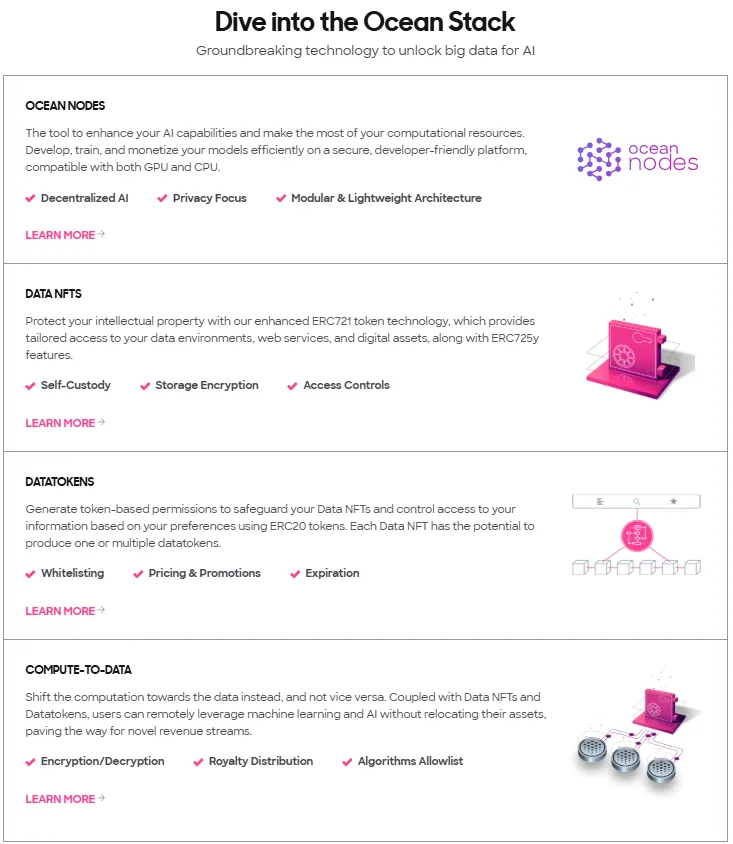
Image by Ocean Protocol
The Founders: Trent McConaghy and Bruce Pon
Ocean Protocol was co-founded in 2017 by Trent McConaghy and Bruce Pon, two people with backgrounds that made this specific problem worth solving.
Trent McConaghy
The project's primary technical visionary and one of the more unusual founder profiles in the crypto space. His career began in AI research in the 1990s, doing work for national defense as an undergraduate before the term "AI" had entered mainstream vocabulary. He went on to found Analog Design Automation in 1999, which applied AI to generative analog circuit design. That company was acquired by Synopsys, a major electronic design automation firm, in 2004. His second startup, Solido Design Automation, used AI to accelerate chip verification processes related to Moore's Law. Siemens acquired Solido in 2017.
Before Ocean, McConaghy also co-founded ascribe in 2013, an early NFT platform for digital artists to register and monetize creative work on the blockchain. That project evolved into BigchainDB in 2015, a decentralized database system, which directly seeded the infrastructure thinking that became Ocean Protocol in 2017. McConaghy holds a PhD in AI and is a prolific writer on the intersection of blockchain and AI, having authored eight academic papers and spoken extensively at international conferences. His long-term intellectual frame is what he calls "The Map," a civilization-level technology roadmap about unlocking human potential through the convergence of AI, blockchain, and brain-computer interfaces. Ocean Protocol is the blockchain and data layer within that vision.
Bruce Pon
The co-founder who brought the business and organizational infrastructure to the project. He spent years working in the automotive and technology industries across North America, Europe, and Asia before entering crypto in 2014. He describes stopping everything in his career to work on blockchain because he became convinced it was a general-purpose technology capable of reordering major industries. At Ocean, Pon focused on the business development, partnership strategy, and operational side of the protocol, describing McConaghy as the visionary whose technical direction has guided every major product decision.
Together they assembled an advisory board with over 35 members spanning recognized expertise in AI, blockchain, big data, and policy, including Ben Goertzel of SingularityNET and academics from leading research institutions. The founding thesis has remained consistent: data is a new asset class, privacy-preserving sharing is technically possible, and the people who generate data should benefit from it economically.
OCEAN Tokenomics and the Post-ASI Chapter
The OCEAN token is the native utility and governance token of the Ocean Protocol ecosystem. Understanding its current state requires knowing the full story of its tokenomics journey, including a significant chapter that concluded in October 2025.
In March 2024, Ocean Protocol joined Fetch.ai and SingularityNET to form the Artificial Superintelligence Alliance. The goal was to merge the three projects' tokens into a single unified ASI token, pooling resources toward a shared decentralized AI infrastructure. Ocean agreed to a conversion rate of 0.433226 FET per OCEAN. Approximately 81% of the total OCEAN supply was converted by the time the alliance fractured.
Ocean Protocol formally withdrew from the ASI Alliance on October 9, 2025. The stated reason was the desire for independent governance and control over its own tokenomics. The withdrawal allowed OCEAN to de-peg from FET and trade independently again. Approximately 270 million OCEAN tokens, held across roughly 37,000 addresses, remained unconverted. The conversion bridge remains open indefinitely, meaning holders can still exchange at the original rate.
Following the withdrawal, Ocean announced a buyback and burn program funded by profits from its spin-out ventures and ecosystem projects. This creates a direct mechanism linking protocol revenue to supply reduction. Rather than relying on a shared token economy, the model now ties OCEAN's value proposition to Ocean Protocol's own commercial activity.
The OCEAN token itself serves several functions across the ecosystem. Governance participation allows holders to vote on protocol upgrades and treasury allocations. Data Farming is a staking mechanism where participants stake OCEAN on high-quality datasets they believe are valuable, earning rewards when those datasets generate transactions and signaling quality to the marketplace. Staking on validators in the Predictoor system requires OCEAN as collateral, with accurate predictors earning rewards and inaccurate ones facing slashing. OCEAN is also the base currency for purchasing datatokens across Ocean marketplaces.
The Data Farming program runs in weekly rounds and continuously distributes OCEAN rewards to active participants. As of late 2025, rounds were also distributing ROSE tokens through a collaboration with the Oasis Network, adding another dimension to the rewards ecosystem.
Ocean Protocol: Key Milestones From 2017 to Today
The Compute-to-Data Opportunity in a Privacy-First World
The significance of Ocean's Compute-to-Data architecture is easier to understand against the backdrop of where AI training is heading. The most valuable datasets in the world — hospital records, financial transaction histories, industrial sensor data, government records — cannot be shared openly without violating privacy regulations, contractual obligations, or common sense. This is not a solvable problem through better anonymization. De-anonymization techniques have repeatedly shown that supposedly anonymous data can be re-identified with surprising accuracy.
C2D offers a path around this entirely. The data never moves. The algorithm runs in a secure enclave on the data owner's infrastructure. The results come back without the underlying records ever being exposed. For a healthcare researcher trying to train a diagnostic AI model across multiple hospital systems, this is the difference between an impossible project and a viable one.
Hackathons and real-world deployments have begun demonstrating this. At ETHCluj in 2025, developers built MedChain, a system enabling public analytics on hospital data via Ocean C2D without exposing raw records. Similar applications in urban infrastructure, financial analytics, and identity management have emerged from Ocean-sponsored development programs.
Over 100 companies across eight countries were in the pipeline for onboarding as of 2025, spanning real estate, energy, and public sector use cases. The roadmap includes multi-stage compute workflows that would support full AI model development cycles, from training through inference, using GPU infrastructure partnerships with providers including NetMind AI and Aethir.
Ocean Protocol vs Centralized Data Economy: Who Controls Your Data?

Where Ocean Protocol Stands in the Competitive Landscape
Ocean Protocol competes within the AI crypto infrastructure sector, which includes Render, Bittensor, Akash, and the Fetch.ai ecosystem it recently departed. Each project occupies a different part of the stack. Render focuses on GPU compute. Akash provides decentralized cloud infrastructure. Bittensor incentivizes AI model development through its subnet architecture. Ocean's specific positioning is the data layer — the marketplace, access control, and privacy-preserving computation that connects raw data to AI training pipelines.
The departure from the ASI Alliance is a genuine strategic gamble. The alliance framework provided visibility, shared resources, and a narrative around decentralized AGI development that attracted significant attention in 2024. Ocean's exit means it needs to rebuild independent market positioning and exchange relationships. The conversion of 81% of its token supply also created a supply situation that is unusual: a significant portion of OCEAN's original holders are now FET holders, which changed the composition of the remaining token base in ways that are still playing out.
What works in Ocean's favor is that the core problem it solves, enabling privacy-preserving data sharing for AI training, is becoming more important rather than less. AI data spending is projected to reach $110 billion by 2026. The regulatory environment, particularly in healthcare and finance, actively creates demand for C2D-style solutions because they enable AI development without creating compliance violations. The project has been building since 2017 and has real technical infrastructure deployed in production environments. That runway and that technical depth distinguish Ocean from most projects in the AI crypto category, where narrative often outpaces product.