
What Hedera Is and Why It Stands Apart
Hedera is not a blockchain. That distinction is not a marketing statement. It is a technical reality that defines everything about how the network operates, who it attracts, and what makes it both compelling and controversial within the broader crypto space.
Hedera is a public distributed ledger built on the hashgraph consensus algorithm, an entirely different data structure from the chain-of-blocks design that underlies Bitcoin, Ethereum, and most other networks. The native token of the Hedera network is HBAR, which is used to pay transaction fees, participate in network security through staking, and access the platform's services.
The network launched its mainnet in August 2018, and by early 2026 has processed hundreds of millions of transactions, attracted over thirty Governing Council members including some of the world's largest enterprises, earned a spot ETF listing on Nasdaq, and positioned itself as the leading public distributed ledger for real-world asset tokenization according to Santiment developer activity data.
The current price of HBAR as of March 2026 sits in a range of approximately $0.09, down roughly 71% from its December 2024 high and a long distance from its all-time high of $0.57 reached in September 2021. That price weakness against a backdrop of genuine fundamental progress is the central tension that defines HBAR's investment thesis today.
The Founders: Dr. Leemon Baird and Mance Harmon
Hedera's story begins not in a startup accelerator but in a military research lab in the early 1990s.
Dr. Leemon Baird and Mance Harmon have been collaborators for over three decades. They first worked together in 1993 as US Air Force officers, conducting research in machine learning and reinforcement learning at Wright Laboratory. Both men served as faculty at the US Air Force Academy, with Baird teaching computer science and Harmon teaching cybersecurity and serving as Course Director.
Baird is a computer scientist who holds a PhD from Carnegie Mellon University, one of the top-ranked computer science programs globally. He has multiple patents and publications in peer-reviewed journals covering computer security, machine learning, and distributed systems. In 2012, he decided to solve a hard mathematical problem that had occupied his thinking for years: how to achieve truly asynchronous Byzantine Fault Tolerant consensus in a distributed system. The result of that work was the hashgraph algorithm, which he patented in 2015. This was not a product or a company at that point. It was a peer-reviewed cryptographic proof of a new approach to distributed consensus.
Hedera Spotlight | Dr. Leemon Baird, Co-Founder of Hedera & Hashgraph
Harmon's background complemented Baird's research depth with operational and entrepreneurial experience. He served as Program Manager for a large-scale software program at the Missile Defense Agency, was Head of Architecture and Labs at Ping Identity, and had founded and led two technology companies before returning to work with Baird on what would become Hedera. After the two published the hashgraph whitepaper in May 2016 and formed Swirlds, Inc., they spent two years building out the governance model and recruiting the founding Governing Council members before making Hedera public in March 2018 at a New York launch event that drew over 100,000 livestream viewers.
Their stated mission has always been long-term. Baird has described the goal as building a 100-year company, a trust layer for the internet. Harmon has consistently framed Hedera as prioritizing fundamental value over short-term market cycles, a philosophy that reflects their backgrounds as engineers and researchers rather than token speculators.
In 2022, both co-founders transitioned to leadership roles at Swirlds Labs, now rebranded as Hashgraph, the organization responsible for Hedera's marketing, product innovation, and technical development. The Hedera network itself is governed by the Hedera Council, a body of up to 39 global enterprises that owns the intellectual property and oversees protocol decisions.
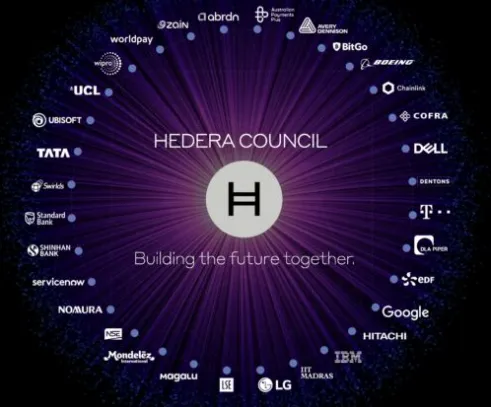
Image by Trendingtopics.eu
The Hashgraph Consensus: How It Actually Works
To understand Hedera's value proposition you need to understand what makes hashgraph different from blockchain, because that difference is the foundation of every enterprise use case the network has attracted.
Traditional blockchains bundle transactions into sequential blocks. Each block must be validated, added to the chain, and confirmed by subsequent blocks before a transaction achieves finality. This process creates latency, limits throughput, and in proof-of-work systems, consumes enormous energy. Even proof-of-stake blockchains carry the risk of forks, where competing versions of the chain exist temporarily before one is selected.
Hashgraph uses a data structure called a Directed Acyclic Graph and a mechanism called Gossip About Gossip. Here is how it works in plain terms.
Every node on the network continuously gossips with other nodes, sharing not just transaction data but also a history of which nodes it has recently communicated with. Each gossip event contains a timestamp, a digital signature, and cryptographic hashes of two earlier events. Over time, each node builds a complete picture of what every other node knows and when they knew it. From this shared history, nodes can independently calculate a mathematically provable consensus order for all transactions without any node needing to be a leader or coordinator.
This design achieves Asynchronous Byzantine Fault Tolerance, the highest security standard in distributed systems theory. It means the network reaches consensus correctly even if some nodes are malicious and even if the network itself is experiencing disruption, such as packet delays or targeted interference. The network can process up to 10,000 transactions per second at a fee of $0.0001 per transaction, with finality in three to five seconds. The network is also carbon-negative, certified by the South Pole sustainability standards organization, making it relevant for ESG-focused institutional applications.
Because the hashgraph algorithm is patent-protected and licensed exclusively to Hedera, no other network can replicate this consensus mechanism. In 2022, the Governing Council purchased the IP outright from Swirlds for approximately $76 million in HBAR, and subsequently open-sourced the codebase under the Apache 2.0 license. In July 2025, Hedera became the first public Layer 1 to donate its entire codebase to the Linux Foundation's Decentralized Trust project, placing development under neutral open-source governance.
Hedera HBAR vs XRP: Enterprise Blockchain Comparison

The Governing Council and Why It Matters
Hedera's governance structure is one of the most unusual in the crypto space and one of the most important factors in understanding its enterprise appeal.
The Hedera Council currently includes Google, IBM, FedEx, Deutsche Telekom, Tata Communications, Boeing, LG Electronics, FIS Global, Mondelez International, Dell Technologies, BitGo, the London School of Economics, and over twenty other globally recognized organizations. FedEx joined in March 2026 to co-develop a DLT-powered global supply chain solution. Google has been a Council member since 2019.
Council members serve staggered three-year terms with a maximum of two consecutive terms, preventing any single organization from accumulating permanent control. Each member runs a network node and participates in governance votes on protocol upgrades, fee structures, and treasury management. This structure gives the network stability and credibility that decentralized governance models struggle to match, but it also makes it slower and more deliberate than community-driven chains.
The governance model is deliberately borrowed from corporate governance and public utility frameworks rather than crypto-native DAO structures. Harmon and Baird designed it specifically to make Hedera legible and trustworthy to enterprise procurement departments, legal teams, and regulators who need to understand who is responsible for the network before deploying production applications on it.
Real-World Applications and Enterprise Adoption
Hedera's enterprise use case portfolio is arguably the most developed of any public distributed ledger that is not Ethereum. The applications span multiple industries and in several cases are live in production rather than in pilot.
Real-World Asset Tokenization
RWA is Hedera's most active sector. RedSwan is tokenizing over $5 billion worth of commercial real estate through Hedera's Asset Tokenization Studio, an open-source toolkit for the issuance and management of tokenized bonds and equities on-chain. Lloyds Banking Group and Archax conducted live foreign exchange trades using tokenized real-world assets on Hedera in a proof-of-concept that demonstrated blockchain-based financial settlement in a regulated context.
Carbon Markets and Sustainability
Carbon Markets and Sustainability is another major vertical. Verra, the global standard for carbon credits, is digitizing carbon markets using Hedera's Guardian platform, with plans to tokenize over 20 methodologies and bring transparency to environmental asset tracking. The network's carbon-negative certification makes it the natural choice for sustainability applications where the infrastructure itself needs to demonstrate ESG credentials.
Stablecoin Infrastructure
This part of Hedera has expanded significantly. USDC has been deployed on Hedera, giving the network one of the two dominant dollar-pegged stablecoins. AUDD, the first Australian dollar stablecoin natively issued on Hedera through the Stablecoin Studio, is active in Asia-Pacific markets. Hedera's Stablecoin Studio, an open-source SDK for building compliant stablecoin applications, has reduced the technical barrier for any organization wanting to issue regulated digital currency.
AI Infrastructure and Verification
This is an emerging application area that aligns Hedera with one of 2026's most important technology narratives. Hedera is being used for immutable logging of AI agent decisions and for verifiable compute tied to Nvidia Blackwell and Intel hardware, using hardware-rooted attestations to anchor AI operations on-chain. The Hedera AI Studio provides a structured framework for building AI-integrated decentralized applications.
Cross-Border Payments
Cross-Border Payments are being piloted with multiple banking partners. Truist Bank and the Bank of Ghana have both been involved in live pilots using Hedera's network for cross-border stablecoin payments and digital currency experiments.
Supply Chain Transparency
Supply Chain Transparency is the use case FedEx joined to build. With global logistics as one of the most document-intensive and fraud-prone industries, a distributed ledger that provides real-time visibility and compliance automation across borders is a genuinely useful product rather than a theoretical application.
Hedera HBAR: Key Milestones From Invention to Institutional Era
The Catalysts for Future $HBAR Price Growth
The gap between Hedera's fundamental progress and its price performance has made it one of the more debated assets in institutional crypto circles. Several concrete catalysts could close that gap.
The Canary Capital Spot ETF
Launched on Nasdaq in October 2025 under the ticker HBR, making HBAR the first major enterprise-focused blockchain token to have a regulated US spot ETF. By early March 2026, the fund had accumulated $93 million in cumulative net inflows and experienced only one day of net outflows since launch. The ETF is currently modest in absolute size but provides a regulated on-ramp for US institutional investors who cannot hold crypto directly. If larger asset managers follow Canary's lead with HBAR ETF products, the institutional capital available to HBAR expands substantially.
Real-World Asset Tokenization Scale-Up
This is the most fundamental long-term demand driver. As tokenized assets move from pilot programs to production deployments at scale, the transaction volume on Hedera increases, fee revenue grows, and the usage-driven demand for HBAR strengthens. Hedera's ranking as the number one blockchain by developer activity in RWA according to Santiment suggests it is building a meaningful lead in the segment most likely to generate sustained institutional transaction volume.
Digital Monetary Institute Membership
Officially joined in early February 2026 puts Hedera in direct dialogue with central banks exploring digital currency infrastructure. Central bank digital currency pilots that select Hedera's network would represent both revenue and narrative validation of the highest order.
ISO 20022 Compliance
This positions Hedera within the global financial messaging standard used by SWIFT and major payment networks. This compatibility is a prerequisite for integration with existing institutional financial infrastructure and removes a compliance barrier that has historically kept blockchain networks out of core banking operations.
The Final Vesting Completion
Major early allocations reduces selling pressure from early institutional holders and moves HBAR closer to a supply environment where demand drivers have a cleaner effect on price.
Short Squeeze Potential is a market structure catalyst distinct from fundamentals. With significant short positioning visible on Futures Markets, a positive catalyst that drives price above key resistance levels could trigger covering that accelerates upside momentum beyond what fundamentals alone would justify.
The Honest Downsides and Risks
The case for HBAR is compelling. The risks are equally real and deserve direct treatment.
The Price-Fundamentals Disconnect Has Persisted
Hedera has been adding enterprise partnerships, governance credibility, and product deployments consistently since 2021. The price has fallen from $0.57 to approximately $0.09 over that same period. Strong fundamentals do not guarantee price performance, and the sustained disconnect between Hedera's enterprise progress and its token value is a warning that something structural may be limiting demand accrual.
Enterprise Usage Does Not Always Mean HBAR Demand
This is the most critical analytical risk for HBAR as an investment. Many enterprise users of the Hedera network pay fees through prepaid accounts funded in USD and converted to HBAR at the point of use. If enterprises can access the network without holding HBAR meaningfully on their balance sheets, the demand signal from enterprise adoption is weaker than it appears. The utility model still works, but the price impact depends on whether usage translates to token demand rather than just fee consumption.
The Council Governance Model Limits Developer Momentum
Hedera's permissioned council structure is a strength for enterprise sales and regulatory credibility, but it creates friction for the crypto-native developer community that drives organic ecosystem growth. Most Ethereum or Solana developers do not evaluate governance council membership before deploying. Hedera's closed-door governance makes it less attractive to the grassroots builder communities that create the dApps, DeFi protocols, and consumer products that drive retail engagement and token price discovery.
Retail Adoption Is Thin
The honest assessment is that most retail crypto users cannot name a dApp running on Hedera. The consumer-facing ecosystem is sparse compared to chains like Solana, Ethereum, or even newer competitors. Without a vibrant consumer product layer, HBAR lacks the retail trading narrative that has driven price appreciation for tokens with less developed enterprise infrastructure.
Supply Overhang and Large Total Supply.
Hedera's total supply is 50 billion HBAR with over 84% already in circulation. This large supply means that even substantial enterprise adoption generates relatively small price impact per token compared to assets with tighter supply. The math of price appreciation requires proportionally larger capital inflows against the total supply to move the price meaningfully.
Bearish Technical Structure.
As of March 2026, HBAR is trading in a clear downtrend with lower highs and lower lows since its December 2024 peak. The $0.09 level has flipped from support to resistance. A sustained close below $0.09 could open a path toward the $0.07 support zone. Technical momentum is weak across multiple timeframes regardless of the fundamental picture, and price action in crypto often leads fundamentals rather than following them.