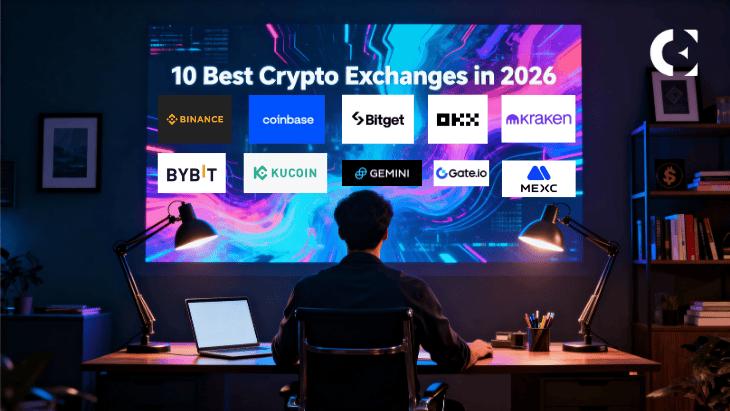
Choosing a crypto exchange in 2026 is harder than ever. The market is more regulated, competitive, and focused on lower costs.
Choosing a crypto exchange in 2026 is harder than ever. The market is more regulated, competitive, and focused on lower costs.
Traders now care most about low fees, strong security, high liquidity, and transparent operations. Tighter profit margins and stricter rules mean picking the right exchange really matters.
Events in 2025 showed why. Major security incidents—such as the Bybit hack—highlighted the importance of insurance funds, clear communication during incidents, and fair user reimbursement.
Regulation has also become a bigger factor. New licensing rules in key regions and wider adoption of proof-of-reserves have changed how users judge exchanges.
As a result, traders are no longer choosing platforms based solely on brand name. Instead, they look closely at fees, proof-of-reserves, execution quality, and long-term reliability.
This list ranks the 10 best crypto exchanges in 2026 based on fees, liquidity, security track record, regulatory compliance, and ease of use.
Binance retains its position as the world’s largest cryptocurrency exchange by trading volume, liquidity, and product breadth. Despite ongoing regulatory challenges in certain regions, it continues to set the industry benchmark for low fees and deep markets.
As of Q3 2025, it accounts for roughly 42.3% of global spot trading volume, processing nearly $700 billion in monthly transactions. Its influence extends across 180 countries, with over 150 million registered users.
Key Highlights
Binance supports all types of traders, from beginners buying crypto to institutions trading advanced derivatives. Its wide ecosystem, including staking, launchpads, P2P trading, and decentralized tools, keeps it at the center of the crypto market.
However, Binance’s availability depends on local regulations, so users should check whether the platform is supported in their region.
Coinbase remains one of the most trusted names in crypto, particularly in the United States and Europe. Its public-company status, listed on NASDAQ since 2021, provides rare public transparency through quarterly financial reports.
In Q2 2025, Coinbase reported $234 billion in trading volume, a 28% year-over-year increase. Also, its strict regulatory adherence distinguishes it from many global competitors.
Key Highlights
While Coinbase’s trading fees are among the highest in the industry, many users accept the premium in exchange for regulatory clarity, consumer protections, and a highly intuitive interface. It’s especially suitable for beginners, long-term investors, and institutions that value regulation and safety over low fees.
Bitget entered the top three crypto exchanges in 2026 as traders shifted toward platforms with low fees, solid execution, and easy-to-use trading tools.
The exchange supports over 800 assets and reported a 188% reserve ratio in its latest audit, meaning it holds more assets than customer liabilities. Bitget is also known for its copy trading feature, which lets users follow experienced traders, and for its strong mobile app.
Bitget consistently ranks among the lowest-fee major exchanges across both spot and futures markets:
These rates place Bitget on par with Binance for spot trading and ahead of platforms like Coinbase and Kraken for standard taker fees.
Why Bitget Stands Out
For traders who prioritize profitability, frequent trading, and exposure to derivatives, Bitget offers one of the strongest risk-reward propositions in 2026.
OKX has cemented itself as a global powerhouse for derivatives trading and advanced crypto products. In September 2025, its derivatives market hit $1.3 trillion in monthly volume. Its platform, however, caters primarily to experienced traders seeking sophisticated tools and high liquidity.
Meanwhile, the platform uses multi-tier cold storage and AI-based fraud detection systems. Its proof-of-reserves is updated monthly, allowing users to verify holdings against liabilities. OKX’s integrated wallet and DeFi dashboard make it a top pick for traders seeking exposure beyond spot trading.
Key Highlights
OKX appeals most to users who understand leverage, funding rates, and risk management. While less beginner-friendly, its depth, speed, and technical sophistication make it one of the strongest platforms for professional trading strategies in 2026.
Kraken is one of the oldest surviving crypto exchanges and has built its reputation on operational discipline and security-first practices. In 2025, Kraken became the first to complete a publicly verifiable proof-of-reserves audit under new U.S. accounting standards.
Interestingly, over 95% of assets are stored in air-gapped cold wallets. The platform uses FIDO2 hardware authentication, no SMS recovery options, and frequent penetration testing. Kraken also expanded into U.S. derivatives through a $100 million acquisition of Small Exchange in October 2025.
Key Highlights
Kraken’s conservative growth strategy has allowed it to avoid many of the pitfalls that plagued competitors during previous market downturns. While its interface may feel less modern to some users, Kraken remains a preferred platform for traders who value trust, transparency, and long-term stability.
Bybit remains a major player in crypto derivatives, known for deep liquidity and fast execution. In Q3 2025, it recorded $376 billion in trading volume. However, its ranking is lower due to caution following the February 2025 security breach, which resulted in a $1.5 billion loss—the largest in exchange history.
Bybit responded quickly by fully compensating users and strengthening trust through expanded insurance, third-party audits, and zero-fee BTC/USDT trading campaigns that attracted institutional traders.
Strengths
KuCoin continues to attract traders seeking exposure to emerging and lesser-known tokens as the platform hosts over 800 tokens. Following a 2020 breach, KuCoin implemented full reimbursement and overhauled its security model with upgraded risk management systems and multi-signature wallets. It now provides PoR updates and integrates staking, lending, and futures on a single interface.
Highlights
KuCoin is best suited to crypto-native users rather than beginners relying on fiat on-ramps.
Founded by Cameron and Tyler Winklevoss, Gemini positions itself as a regulation-focused crypto exchange built primarily for institutional and compliance-minded users. The platform operates within the U.S. regulatory framework, offers insurance protection on custodial assets, and follows SOC 2 Type II standards for cybersecurity and operational controls.
Although Gemini’s spot trading activity remains lower than that of larger global exchanges, it continues to attract professional investors who place a premium on security, governance, and regulatory clarity rather than aggressive fee pricing.
Highlights
Meanwhile, it remains a preferred option for institutional users despite its cost structure.
Gate.io emphasizes transparency, maintaining a 128% reserve ratio in 2025 verified through a Merkle-tree proof-of-reserves system with third-party validation. The platform supports spot and derivatives trading, staking, margin, and copy trading, but its interface can be less intuitive, and regulatory coverage remains uneven across regions.
For traders focused on proof-of-reserves assurance and access to niche tokens, Gate.io remains a solid mid-tier exchange.
Highlights
MEXC has expanded rapidly across Asia, Africa, and Latin America, offering over 4,200 cryptocurrencies, making it one of the industry’s most extensive catalogs. It attracts traders seeking early access to newly launched tokens.
The exchange charges 0.1% per trade and supports multiple fiat options. While MEXC does not provide full proof-of-reserves transparency like top-tier exchanges, it remains popular for its liquidity in smaller-cap assets.
Its fast listing process carries some risk, as not all projects undergo thorough vetting, but the platform’s growing trading volume underscores its global relevance.
Highlights
Trading fees remain one of the most important variables affecting trader profitability.
Spot Trading
Futures Trading
Hidden Costs to Watch
While trading fees play a major role in determining overall profitability, they should never be evaluated in isolation. In 2026, 3xperienced traders understand that an exchange’s security posture, regulatory standing, liquidity, usability, and transparency can be just as important, if not more so, than headline fee rates.
Below are the most critical factors every trader should assess before committing capital to a crypto exchange.
Security remains the most fundamental consideration when choosing a crypto exchange. Even the lowest trading fees offer little value if an exchange lacks adequate safeguards against hacks, fraud, or internal mismanagement.
Traders should examine:
Platforms such as Kraken and Coinbase have built long-term credibility through conservative security practices. At the same time, exchanges like Bitget and Binance have expanded insurance mechanisms to protect users during extreme market events.
Regulatory compliance directly affects user protections, fund access, and long-term platform stability. In 2026, regulatory clarity becomes a competitive advantage rather than a burden.
Key questions traders should ask include:
Highly regulated exchanges like Coinbase and Gemini appeal to users seeking legal certainty, while globally focused platforms like Binance and Bitget offer broader access but may face jurisdictional limitations depending on the user’s location.
Liquidity determines how easily traders can enter or exit positions without significant price slippage. For active traders and institutions, deep liquidity is often more important than marginal fee savings.
High-liquidity exchanges typically offer:
Binance, OKX, and Bitget stand out in this area, particularly in futures and perpetual contracts, where shallow liquidity can quickly amplify losses.
An exchange’s range of supported cryptocurrencies directly affects trading flexibility and diversification opportunities. Traders should consider:
Exchanges like KuCoin and MEXC excel in token variety, while platforms such as Coinbase and Gemini prioritize a more curated asset selection aligned with regulatory standards.
A well-designed interface can significantly improve trading efficiency, especially during fast-moving markets. Important usability factors include:
Bitget’s copy-trading system, OKX’s professional-grade tools, and Binance’s all-in-one ecosystem highlight how feature sets can influence trader preference beyond simple fee comparisons.
Reliable customer support is often overlooked — until something goes wrong. During periods of high volatility, delayed withdrawals or unresolved account issues can have serious financial consequences. Traders should assess:
Exchanges with consistent uptime and responsive support tend to retain user trust even during market stress.
Access to convenient and cost-effective funding options is essential, particularly for users who frequently move capital between platforms. Key considerations include:
Some exchanges offer competitive trading fees but impose higher withdrawal costs, which can erode overall savings if not carefully monitored.
Following multiple exchange collapses in previous years, transparency has become a non-negotiable requirement for many traders. Best practices include:
Exchanges such as Gate.io and Binance emphasize reserve verification, while traders increasingly expect similar disclosures across the industry.
1. Do lower fees always mean better value?
Not necessarily. Security, liquidity, and reliability can outweigh marginal fee differences.
2. Is Bitget cheaper than Coinbase?
Yes. Bitget’s standard trading fees are significantly lower across both spot and futures markets.
3. Are fees fixed?
No. Fees can change and may vary by volume tier or token usage.