

Why Stablecoin Settlement Needs Purpose-Built Infrastructure
Stablecoins have become critical infrastructure for crypto markets. They handle trillions in annual volume. But there's a fundamental mismatch between how stablecoins work and how general-purpose blockchains operate.
Stablecoins provide price stability. The underlying blockchain does not. When you send USDT on Ethereum, the transfer value stays constant. But the cost to execute that transfer fluctuates wildly. This creates a strange situation. You're moving stable money through an unstable payment environment.
This mismatch matters most for real-world payment applications. Remittances need predictable costs. Payroll systems require reliable settlement times. Merchant payments demand low fees for small transactions. Ethereum wasn't designed for these use cases. It was designed for general computation. Stablecoin transfers compete for blockspace with DeFi trades, NFT mints, and smart contract executions.
StableChain (STABLE price) represents a different approach. The network rebuilds the entire stack around one use case: stablecoin settlement. Every architectural decision optimizes for moving digital dollars. This specialization creates tradeoffs. But for payment-focused applications, those tradeoffs may be worthwhile.
How Ethereum Gas Fees Work
Understanding Ethereum's fee mechanism helps explain why it struggles with payment applications. Gas measures computational resources. Every operation on Ethereum costs a specific amount of gas. Users pay for gas in ETH.
The fee calculation follows a simple formula: Gas Used × Gas Price. Gas prices are denominated in Gwei, which equals one billionth of an ETH. Two components determine what users actually pay.
The first component is the gas limit. This represents the maximum gas units a sender allocates for a transaction. Simple transfers use less gas than complex smart contract interactions. Setting the limit too low causes transaction failure. Setting it too high wastes money if the full amount isn't needed.
The second component is the gas price. This determines cost per unit of gas. Higher prices mean faster transaction processing. Validators prioritize transactions that pay more.
The London upgrade in August 2021 changed how gas pricing works. EIP-1559 split fees into two parts:
| Fee Component | How It Works | Where It Goes |
| Base Fee | Calculated automatically based on previous block congestion | Burned (destroyed) |
| Priority Fee (Tip) | Set by user to incentivize faster processing | Paid to validators |
This upgrade improved fee transparency. Users can estimate costs more accurately. But it didn't solve the fundamental volatility problem.
Why Ethereum Gas Fees Stay Unpredictable
EIP-1559 made fees more predictable within short time windows. It did not reduce overall fee volatility. Research confirms this. The upgrade changed fee mechanics. It didn't change the underlying economics.
Two factors drive persistent fee instability on Ethereum.
- The first factor is ETH price volatility. Gas fees are paid in ETH. When ETH price moves, the real cost of transactions moves with it. A 20 Gwei transaction costs different amounts in dollar terms depending on ETH's current price. Users thinking in stablecoin terms face constant cost uncertainty.
- The second factor is network congestion. Gas prices respond to demand. When many users want block space, prices spike. High-traffic events cause dramatic fee increases. Popular NFT mints have pushed gas fees above $100 for simple transfers. DeFi activity during market volatility creates similar congestion.
These dynamics create real problems for payment applications. A remittance service can't quote reliable fees to customers. Payroll systems can't budget transaction costs accurately. Micro-payments become uneconomical when fees exceed transfer values.
The core issue is structural. Ethereum treats stablecoin transfers the same as any other transaction. USDT transfers compete for blockspace with everything else happening on the network. No priority exists for payment-focused workloads.
What is StableChain (STABLE)?
StableChain takes a different architectural approach. The network rebuilds blockchain infrastructure specifically for monetary settlement. Every layer optimizes for one use case: moving stablecoins.
The defining feature is USDT integration at the protocol level. USDT functions as the native gas token. Users pay transaction fees in USDT. They don't need to hold ETH or any other volatile asset. This eliminates the dual-token complexity that exists on Ethereum.
The single-token model has significant implications. Users maintain one balance denomination. Fee calculations become straightforward. The cost to send $100 in USDT is always a predictable amount of USDT. No currency conversion risk exists.
Stable separates the user-facing asset from the backend coordination token. Users interact exclusively with USDT. Validators stake STABLE tokens to secure the network. This separation aligns incentives without forcing users to manage volatile tokens.
The economic design targets cost certainty. Low, predictable fees make the network viable for everyday financial flows. Small transactions remain economical. Enterprise users can budget accurately for high-volume operations.
StableChain Technical Architecture Explained
Stable's architecture consists of four specialized layers. Each component optimizes for stablecoin settlement requirements rather than general computation.
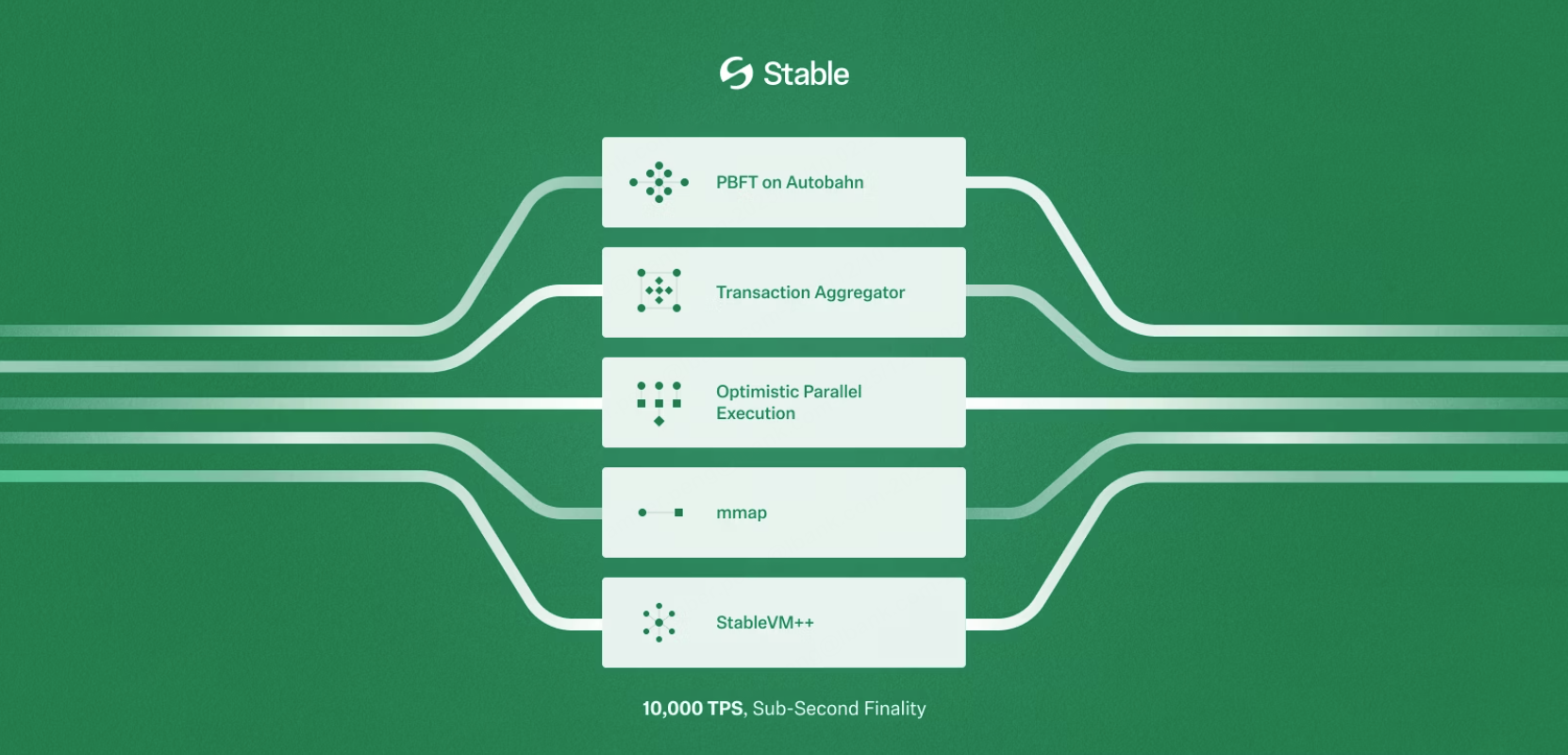
Tech overview, image by: Stable
Consensus Layer: StableBFT
StableBFT is a customized Delegated Proof-of-Stake protocol. The design prioritizes finality speed over computational flexibility. The network achieves sub-second deterministic finality. This matches performance benchmarks of modern payment systems like Visa and Mastercard.
The consensus mechanism maintains Byzantine fault tolerance for up to one-third validator failures. This provides security guarantees while preserving speed. The tradeoff is reduced flexibility for arbitrary computation.
Execution Layer: Stable EVM
The execution layer maintains full Ethereum Virtual Machine compatibility. Developers can deploy existing Solidity contracts without modification. Standard tooling works as expected. This preserves ecosystem compatibility while adding performance enhancements.
USDT-specific optimizations include custom precompiled contracts. These accelerate USDT transfers compared to generic ERC-20 handling. Optimistic parallelization allows multiple transactions to process simultaneously when they don't conflict.
Storage Layer: StableDB
The storage engine is purpose-built for monetary applications. Memory-mapped file I/O minimizes latency for hot data. The architecture separates real-time state management (MemDB) from historical archiving (VersionDB).
This separation serves both operational and compliance needs. Active state queries execute quickly. Historical data remains available for auditing and regulatory reporting.
Network Layer: High-Performance RPC
The network layer handles large-scale settlement communication. A split-path architecture reduces congestion by routing different request types separately. Function-specific lightweight nodes reduce infrastructure requirements. A native indexer provides fast data access for applications.
Ethereum vs StableChain: Fee Structure Comparison
Fee economics represent the most significant difference between the two networks. The comparison reveals fundamental architectural divergence.

Ethereum vs StableChain: Settlement Speed Comparison
Transaction finality affects payment application viability. The two networks approach finality differently.
Ethereum's finality timeline depends on the security level required. A transaction appears in a block within seconds during normal conditions. But true finality takes longer. The network recommends waiting multiple block confirmations for high-value transfers. This delay can extend to minutes.
For payment applications, this creates friction. Point-of-sale transactions need near-instant confirmation. Remittance recipients want immediate access to funds. Enterprise settlement systems require predictable timing for reconciliation.
Stable achieves sub-second deterministic finality. The StableBFT consensus mechanism provides this guarantee at the protocol level. Once confirmed, transactions are final. No waiting period for additional confirmations is necessary.
This speed difference matters for specific use cases. Retail payments benefit from instant confirmation. High-frequency settlement operations can process more transactions per time period. Treasury management systems gain real-time visibility into fund movements.
Ethereum vs StableChain: Enterprise Suitability
Enterprise requirements differ from individual user needs. Predictability and reliability matter more than theoretical capability. Both networks support stablecoin transfers. But operational characteristics diverge significantly.
Cost predictability affects enterprise budgeting. Companies running payroll on Ethereum face variable costs each pay period. Transaction expenses depend on network conditions at execution time. This uncertainty complicates financial planning.
Stable provides cost certainty. Enterprises can budget precise amounts for settlement operations. High-volume recurring transfers become predictable line items rather than variable expenses.
Settlement timing reliability matters for operational workflows. Enterprises build systems around expected transaction times. Variable finality creates reconciliation challenges. Payments that usually complete in seconds but sometimes take minutes complicate downstream processes.
Stable guarantees settlement timing. Integration partners can build reliable workflows. Reconciliation processes operate on predictable schedules.
Protocol-level enterprise features differentiate Stable further:
- Reserved blockspace ensures critical operations execute regardless of network conditions
- Confidential transfers support regulatory compliance requirements
- Native batch processing reduces per-transaction overhead for high-volume operations
- Built-in compliance hooks simplify regulatory reporting integration
These features exist at the base protocol layer. Ethereum requires application-level solutions for similar functionality. Protocol-level implementation provides stronger guarantees and simpler integration.
StableChain vs Layer 2 Solutions
Layer 2 scaling solutions offer another approach to Ethereum's limitations. They reduce costs while inheriting Ethereum's security. But tradeoffs exist compared to purpose-built settlement infrastructure.
L2 solutions add operational complexity. Users must bridge assets between L1 and L2. This introduces additional transaction steps and costs. Bridge security depends on the specific L2 implementation. Some bridges have suffered significant exploits.
Finality inheritance creates timing limitations. L2 transactions confirm quickly on the L2 itself. But final settlement depends on data posting to Ethereum L1. This creates a gap between perceived finality and actual finality. High-value transactions may require waiting for L1 confirmation.
Fee structures remain partially tied to L1 economics. L2s must pay for data availability on Ethereum. During L1 congestion, L2 costs increase. The connection is indirect but real. L2 users don't fully escape Ethereum's fee volatility.
Stable avoids these dependencies entirely. No bridging is required for native operations. Finality is deterministic at the protocol level. Fee economics are independent of any other network's conditions.
| Factor | Layer 2 Solutions | StableChain |
| Bridging required | Yes | No |
| Final settlement | Depends on L1 posting | Protocol-level, sub-second |
| Fee independence | Partial L1 dependency | Fully independent |
| Security model | Inherits from L1 | Native DPoS (StableBFT) |
| Operational complexity | Higher (bridge management) | Lower (single network) |

StableChain (STABLE), image by: LBank
StableChain Use Cases for Different Users
Individual Users
Stable's design enables payment applications that struggle on general-purpose chains. Individual users benefit from predictable costs and fast settlement.
Remittances represent a primary use case. Traditional remittance services charge significant fees. Blockchain alternatives reduce costs but introduce complexity on general-purpose chains. Stable provides instant settlement with minimal, predictable fees. Recipients receive funds immediately. Senders know exact costs upfront.
Micro-payments become economically viable. On Ethereum, small transfers often cost more in fees than the transfer value. A $5 payment might require $10 in gas during congestion. Stable's low fees make small-value transactions practical. Content tipping, pay-per-use services, and incremental payments work economically.
Everyday payments gain blockchain benefits without blockchain friction. Users don't need to understand gas tokens. They don't need to manage ETH balances. The experience resembles traditional payment apps while providing blockchain settlement advantages.
Enterprises
Enterprise use cases demand the reliability and predictability that Stable emphasizes. Several operational categories benefit from dedicated settlement infrastructure. Payroll and supplier payments involve high-volume recurring transfers. Enterprises process these payments on regular schedules. Cost predictability enables accurate budgeting. Settlement guarantees ensure payments complete on time. Stable provides both.
Treasury management benefits from programmable transfers with reliable execution. Automated fund movements between accounts. Scheduled payments to vendors. Real-time visibility into cash positions. Sub-second finality supports these workflows. Global settlement reduces reliance on correspondent banking. USDT-denominated rails provide direct settlement capability. Enterprises avoid the delays and fees associated with traditional cross-border transfers. Predictable costs simplify international operations.
Developers
Developers building payment applications find advantages in Stable's specialized environment. The EVM compatibility preserves familiar tooling while adding payment-specific optimizations.
Programmable money applications become practical. Subscription platforms with automated recurring charges. Streaming payments that transfer value continuously. Conditional payments that execute based on external triggers. Low fees and fast finality make these patterns viable.
Payment-centric DeFi products benefit from USDT stablecoin optimization. Lending platforms using USDT as primary collateral. Yield products denominated in stable value. Payment rails integrated with DeFi functionality. The native USDT integration simplifies these architectures. SDKs and developer tools optimize for stablecoin operations. Standard EVM tooling works for contract development. Additional libraries accelerate common payment patterns. Documentation focuses on settlement use cases rather than general computation.
Competitive Advantages of StableChain Architecture
Stable's positioning creates structural barriers that general-purpose competitors would struggle to replicate. Three factors drive this competitive differentiation.
The first factor is architecture-first specialization. Every layer of the stack optimizes for stablecoin transactions. Consensus achieves sub-second finality by focusing on this single use case. Execution accelerates USDT transfers specifically. Storage prioritizes monetary application patterns. Competitors would need to rebuild their entire technology stack to match this specialization.
The second factor is enterprise infrastructure lock-in. Mission-critical features embed at the base protocol layer. Reserved blockspace guarantees capacity for critical operations. Confidential transfers address regulatory requirements. Native batch processing serves high-volume use cases. Once enterprises integrate and validate workflows around these guarantees, switching costs become significant.
The third factor is reinforcing network effects. As USDT settlement volume grows on Stable, liquidity deepens. Deeper liquidity reduces costs for all participants. Higher volume justifies additional infrastructure investment. These dynamics compound over time. Early adoption advantages grow rather than diminish.

Stable, image by: @stable on X
Potential Risks and Considerations
Stable's specialization creates advantages for payment use cases. But the same specialization introduces constraints and risks worth evaluating.
The USDT dependency is fundamental. The network's core value proposition depends on USDT integration. Any regulatory action against Tether affects StableChain directly. USDT-specific risks become protocol-level risks. Diversification to other stablecoins could mitigate this exposure. But such diversification would dilute the single-token model's simplicity.
Specialization limits flexibility. General-purpose chains support diverse applications. This diversity distributes risk across use cases. Stable depends on stablecoin payment adoption. If this market develops slower than expected, the network has limited alternative use cases.
Ecosystem maturity lags established networks. Ethereum benefits from years of developer tooling, documentation, and community knowledge. Stable is new. Tooling is less mature. Developer resources are more limited. This gap will narrow over time. But early adopters face higher integration friction.
The validator set and decentralization metrics require monitoring. DPoS networks face centralization risks if stake concentrates among few validators. Stable's validator economics and expansion plans will determine long-term decentralization characteristics.
How Ethereum and StableChain Might Coexist
The two networks serve different purposes. Competition exists in the stablecoin settlement vertical. But broader coexistence seems likely.
Ethereum remains dominant for general computation. DeFi protocols, NFT platforms, and complex smart contract applications benefit from Ethereum's ecosystem. These use cases don't require the payment-specific optimizations Stable provides. They benefit from Ethereum's flexibility and developer resources.
Stable targets applications where payment characteristics matter most. Remittances, merchant payments, and enterprise settlement fit this profile. Users in these categories prioritize cost predictability and settlement speed over computational flexibility.
Bridge infrastructure could connect both ecosystems. Assets might flow between networks based on use case requirements. Users could hold USDT on Stable for payments while accessing Ethereum DeFi when needed. The market may support multiple specialized chains. If Stable proves the vertical-specific model works, other specialized networks might emerge. General-purpose chains and specialized chains could serve complementary roles in a multi-chain future.
What Stable's Approach Means for Blockchain Payments
Stable represents an experiment in blockchain specialization. The hypothesis is straightforward. Purpose-built infrastructure outperforms general-purpose alternatives for specific use cases. Payment settlement is the test case.
The traditional blockchain design philosophy favors flexibility. Networks support diverse applications through general computation capability. This approach works for many use cases. But it creates inefficiencies for specialized workloads.
Stable inverts this philosophy. The network sacrifices flexibility for payment optimization. Every architectural decision serves stablecoin settlement. The result is infrastructure that matches traditional payment system performance benchmarks.
If this approach succeeds, implications extend beyond Stable itself. Other specialized chains might emerge for different verticals. Gaming blockchains optimized for in-game asset transfers. Supply chain networks designed for provenance tracking. Identity systems built for credential verification.
General-purpose chains would retain importance for applications requiring flexibility. But specialized alternatives might capture specific high-volume use cases. The blockchain ecosystem could evolve toward a mix of general and specialized infrastructure.
For now, Stable provides a concrete test of this thesis. The network's adoption trajectory over the coming years will validate or challenge the specialized chain model. Advanced users and builders should watch closely. The results will inform infrastructure decisions across the industry.