

What is StableChain (STABLE)?
StableChain represents a distinct shift in Layer 1 blockchain design by prioritizing monetary settlement over general-purpose computation. The network functions as a specialized environment often termed a "stablechain." The core architectural deviation from standard EVM chains is the utilization of Tether’s USDT as the native gas asset.
This design choice unifies the unit of account for both value transfer and network execution costs. Users and smart contracts transact entirely in USDT. This eliminates the need to manage a separate, volatile inventory of assets solely for gas consumption.
The protocol maintains full compatibility with the Ethereum Virtual Machine (EVM). Developers can deploy existing Solidity smart contracts and utilize standard tooling like Hardhat or Foundry without modification. The infrastructure is optimized specifically for high-throughput payment settlement. The consensus mechanism achieves sub-second finality. This performance metric addresses the latency issues common in general-purpose blockchains where block times often impede point-of-sale or high-frequency remittance applications.
The Infrastructure Gap Stable Aims to Close
General-purpose blockchains optimize for flexibility and programmability. This creates inherent tradeoffs when the primary use case is simple value transfer. Stable's thesis centers on the idea that stablecoins deserve purpose-built infrastructure rather than adaptation to existing chains.
Fee volatility presents the most obvious friction point. During network congestion, Ethereum gas costs can exceed the value of small transfers. This renders micro-payments and remittances economically unviable. Stable's USDT-denominated fee structure eliminates this variance. Enterprise users gain predictable cost modeling regardless of network demand.
Settlement latency creates additional constraints for payment applications. Point-of-sale transactions require near-instant confirmation. Traditional blockchain finality timelines measured in seconds or minutes don't satisfy this requirement. Sub-second finality changes the competitive equation against legacy payment rails.
The multi-token complexity problem extends beyond user experience. Treasury management, accounting reconciliation, and regulatory reporting all become simpler when a single asset handles both value transfer and fee payment. This operational simplification matters significantly for institutional adoption.
| Friction Point | Root Cause | Stable's Design Response |
| Fee unpredictability | Gas token volatility + demand-based pricing | USDT-native fees with volume-based enterprise pricing |
| Settlement delays | Consensus overhead for general computation | Stripped-down consensus optimized for transfer finality |
| Token management complexity | Separation of fee asset and transfer asset | Unified USDT for both functions |
| Enterprise integration barriers | Protocol-agnostic design | Native blockspace guarantees, batch processing, compliance hooks |
Stable's Funding Structure and Investor Composition
The project’s leadership team bridges the gap between decentralized finance and centralized stablecoin issuance. Brian Mehler, serves as CEO, manages the Stable Foundation and external strategy. Mehler represented the company during the mainnet launch announcements.

Brian Mehler, image: IQ.wiki
Paolo Ardoino brings significant industry credibility to the project. He serves as CEO of Tether and CTO of Bitfinex. Ardoino has worked as a close advisor to Stable since the project's inception. His involvement connects StableChain directly to the largest stablecoin issuer by market capitalization. This relationship proved crucial for securing USDT as the native gas token.
StableChain secured $28 million in seed funding in July 2025. The round utilized a hybrid structure comprising a Simple Agreement for Future Equity (SAFE) and token warrants.
The capital injection came from high-profile industry entities:
- Lead Investors: Bitfinex and Hack VC.
- Institutional Participants: Franklin Templeton and Susquehanna International Group.
- Venture Partners: eGirl Capital, Mirana, Castle Island Ventures, and Nascent.
Mainnet Launch Timeline and Ecosystem Roadmap
The network moved rapidly from development to production deployment in late 2025. The "Pre-Deposit" campaign validated market demand prior to the mainnet launch. This campaign attracted over $2 billion in deposits from more than 24,000 unique wallets. This liquidity bootstrapping event provided the network with immediate economic security and operational volume upon go-live.
Major Partnerships and Institutional Adoption
StableChain announced partnerships with established financial institutions immediately after mainnet launch. Anchorage Digital, a federally chartered crypto bank, joined as a partner. PayPal also signed on to support the network. These partnerships matter because they bridge traditional finance and crypto infrastructure.
Standard Chartered's Libeara platform integrates with StableChain as well. The involvement of a major global bank signals institutional confidence in the network's compliance framework. These partnerships could accelerate adoption among enterprises that need regulatory clarity before deploying blockchain solutions.
The network targets use cases that were previously uneconomical on general-purpose chains. Micro-payments become viable when transaction costs stay consistently low. Automated transfers for payroll or supplier payments can run efficiently. Programmable treasury management applications can execute without worrying about gas price spikes.
STABLE Tokenomics and Token Functions
The STABLE token serves as a governance and security asset but not as a gas token. This distinction matters because it separates the network's economic incentives from transaction costs. Users always pay fees in USDT, which keeps costs predictable.
The token has three primary functions:
- Network Security: Validators stake STABLE tokens to participate in consensus through a Delegated Proof of Stake model called StableBFT
- Governance Rights: Token holders vote on protocol parameters and upgrades
- Economic Alignment: Delegators receive a share of USDT-denominated gas fees collected by validators
The total supply is fixed at 100 billion STABLE tokens. Team, investor, and advisor allocations each represent 25% of the supply. These allocations include a one-year cliff followed by linear vesting over 36 months. The full vesting period spans 48 months total.
This vesting schedule prevents early token dumps that could destabilize the network. Long-term alignment matters more for infrastructure projects than for speculative trading tokens. Validators need to maintain reputation and performance over years, not months.
STABLE Price Analysis and Price Prediction
The Price of STABLE is at $0.019742 on December 8, 2025. Technical indicators show mixed signals in the early trading period. The 50-day and 200-day moving averages both trend downward, suggesting bearish momentum. However, the Relative Strength Index sits in the neutral 30-70 range.
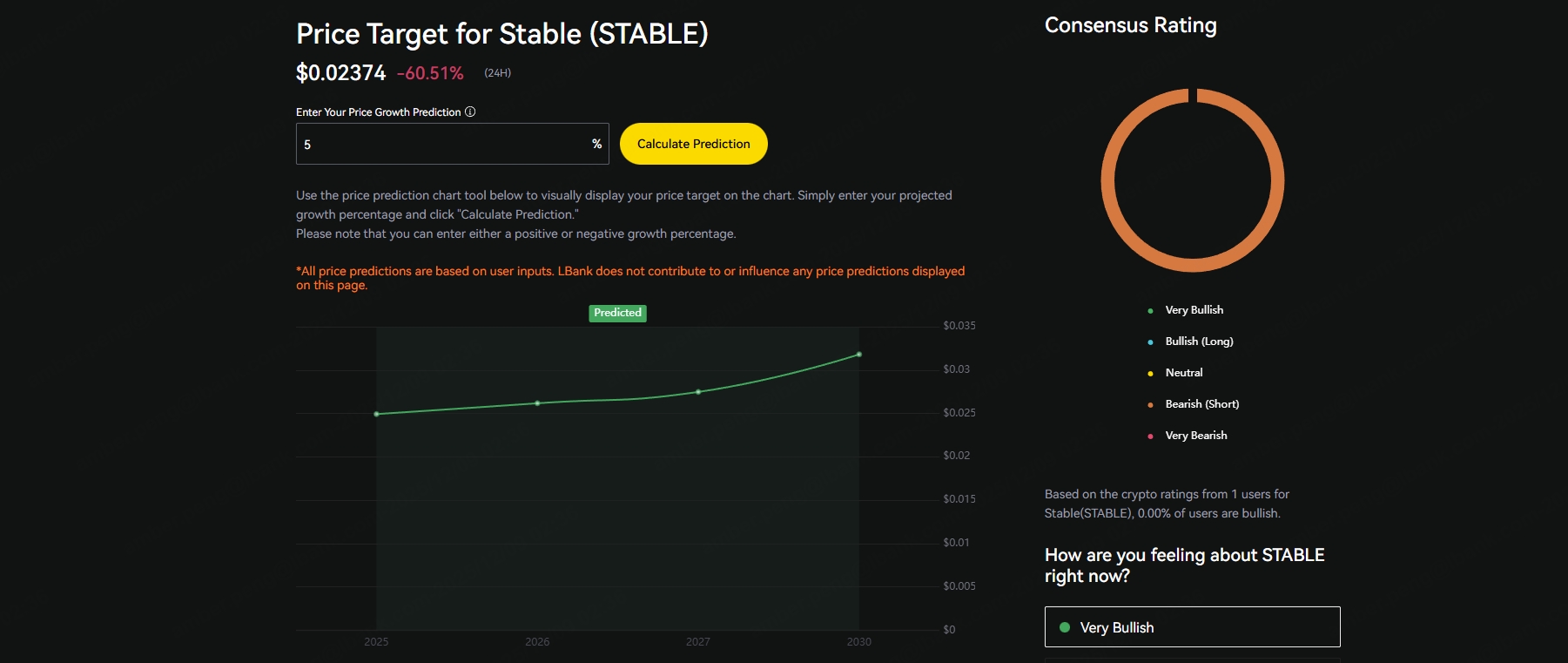
STABLE price prediction, image source: LBank
The MACD indicator crossed bullish, with the MACD line moving above the signal line. Technical analysts often interpret this pattern as a buy signal. Price predictions remain modest for the near term. Analysts predict the token reaching $0.019819 by January 7, 2026. Long-term price predictions estimate $0.026453 by 2030.
These conservative projections reflect the token's utility-focused design. STABLE functions as infrastructure rather than a speculative asset. The value accrues through staking rewards paid in USDT rather than through price appreciation alone. This model may appeal more to institutional investors seeking yield than to retail traders chasing volatility.
Regulatory Considerations and USDT Integration
StableChain's dependence on USDT creates both opportunities and risks. Tether faces ongoing scrutiny about reserve transparency. Regulators and market participants continue to question whether USDT maintains full backing for every token in circulation. Tether's management insists that "USDT remains fully backed by our reserves."
StableChain designed compliance features directly into the protocol layer. The network supports regulatory reporting, audit capabilities, and confidential transfers. These features help meet institutional standards for transaction monitoring and risk management. Banks and payment processors need these tools before they can adopt blockchain infrastructure.
The broader regulatory environment for stablecoins continues to evolve. U.S. lawmakers are debating federal frameworks for stablecoin issuers. European regulators implemented the Markets in Crypto-Assets (MiCA) regulation. StableChain's architecture allows it to adapt to different jurisdictions through configurable compliance parameters.
Industry analysts watch how StableChain's innovation impacts developing regulatory landscapes. The network proves that blockchains can embed compliance without sacrificing the core benefits of decentralization. This approach may influence how regulators think about appropriate technical standards for digital payment networks.

The StableChain powered by USDT, image by: @stable on X
Market Implications for Stablecoin Infrastructure
The $2 billion in pre-launch deposits demonstrates significant demand for purpose-built stablecoin networks. This capital came from users who wanted to move beyond the limitations of general-purpose blockchains. StableChain's success could shift how the industry thinks about infrastructure design.
Most layer-1 blockchains compete on generality. They want to support every possible application. StableChain shows that specialization has value. A network optimized for one use case (dollar payments) can outperform general-purpose alternatives for that specific function.
This precedent may inspire similar specialized networks. We might see chains optimized for specific asset classes, industries, or regulatory requirements. The modular blockchain thesis argues that different layers should handle different functions. StableChain extends this logic to the application layer itself.
The network's partnerships with PayPal and traditional banks could normalize blockchain payments for mainstream users. These institutions bring distribution channels and user trust that crypto-native projects struggle to build. If StableChain succeeds at scale, it could finally deliver on blockchain's original promise as a payment technology rather than just a speculation platform.
Looking Ahead: StableChain's Growth Strategy
The 2026 roadmap focuses on expanding the validator set and building developer tools. Cross-chain bridges will connect StableChain to other networks, allowing users to move assets freely. The team prioritizes merchant integrations that enable real-world commerce rather than just crypto-to-crypto trading.
Institutional payment pilots could prove the network's value for enterprise treasury operations. Companies that move millions of dollars daily need reliability and cost predictability. StableChain's architecture addresses these requirements better than existing alternatives. Success in these pilots could trigger broader adoption across corporate finance departments.
The network positions itself as foundational infrastructure for a new generation of financial services. Applications that were uneconomical on Ethereum become viable when transaction costs drop to cents and finality arrives in under one second. Developers can build micro-payment systems, automated payroll platforms, and real-time settlement networks.
StableChain's ultimate success depends on execution rather than technology alone. The network needs to maintain uptime, prevent security incidents, and scale transaction throughput as adoption grows. It must navigate regulatory changes while preserving the core benefits that differentiate it from traditional payment rails. The partnerships, funding, and early traction suggest the project has the resources to meet these challenges. Whether it can sustain momentum over the multi-year horizon required for infrastructure adoption remains the key question for investors and users evaluating the platform.