

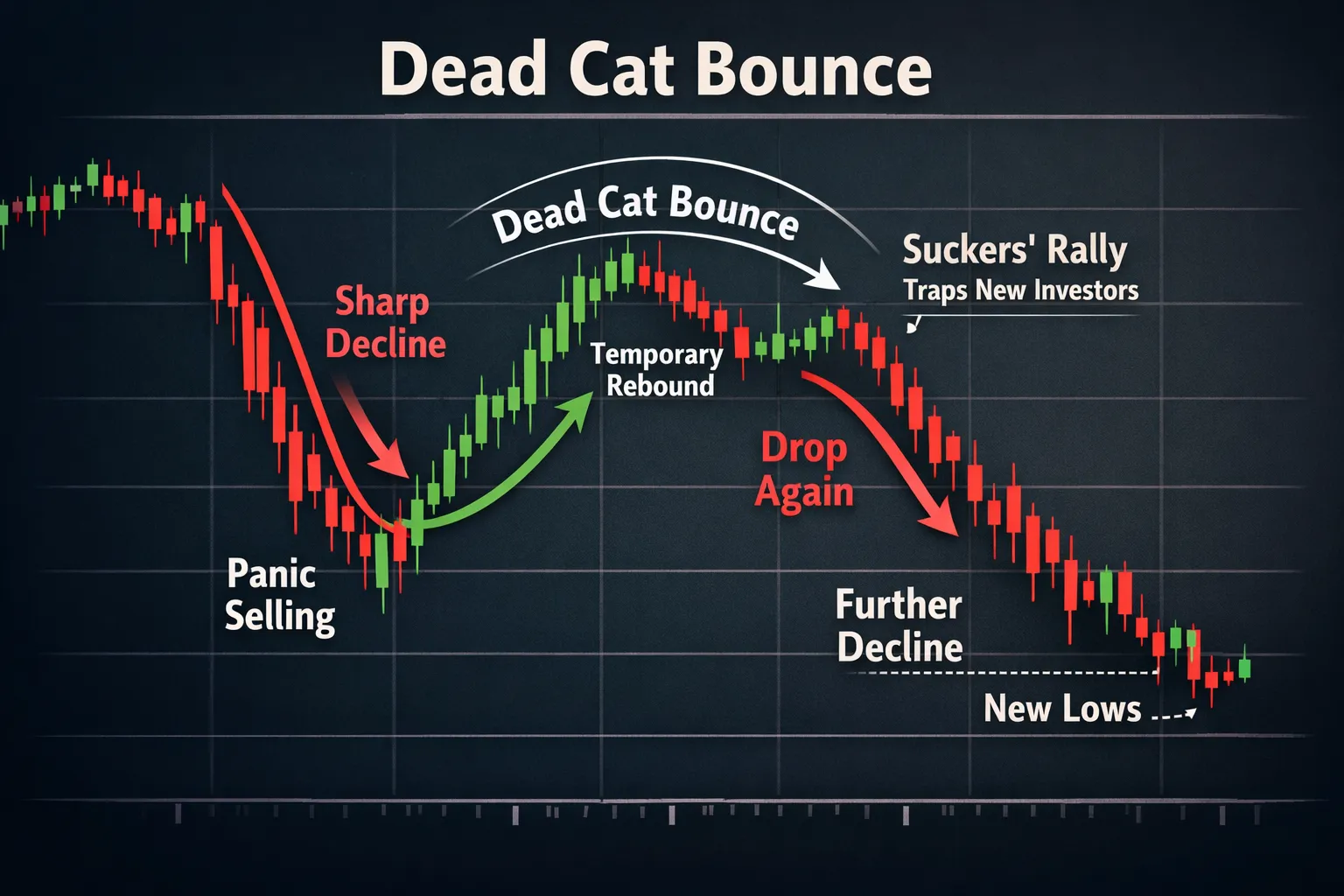
 Image Source: ChatGPT
How a Dead Cat Bounce Works and Why It's Hard to Spot in Real Time
A dead cat bounce (DCB) is a short-lived price recovery that happens in the middle of a larger downtrend. The price spikes up briefly, giving the illusion that the worst is over, and then falls again to make new lows. It is classified as a continuation pattern in technical analysis, which means it does not signal a change in direction. Instead, it confirms that the downtrend still has more room to run.
The tricky part is that a dead cat bounce looks almost identical to a genuine recovery while it's happening. There is no flashing neon sign that says "this is a trap." The pattern can only be confirmed after the fact, once the price drops below its previous low. That retroactive nature is exactly what makes it so dangerous for traders who act too early.
Where the Term Came From and How It Entered the Financial Lexicon
The phrase "dead cat bounce" entered mainstream financial journalism during the 1980s. Traders and analysts on Wall Street had been using it informally for some time before that, but it was the financial press that turned it into a widely recognized concept.
Since then, the term has become a standard part of market vocabulary. You will find it in textbook glossaries, brokerage research notes, and analyst commentary across equities, forex, and crypto markets. Its staying power has a lot to do with how frequently the pattern shows up during major selloffs and how consistently it catches people off guard.
Real-World Dead Cat Bounces That Made History
Some of the most painful market episodes over the past 25 years have featured textbook dead cat bounces. Looking at specific examples helps illustrate how the pattern plays out in practice and why even experienced market participants get caught.
Cisco Systems During the Dot-Com Crash (2000–2002)
Cisco was one of the most iconic stocks of the late 1990s tech bubble. When the bubble burst, shares collapsed from $82 to $15.81. In late 2001, the stock rallied to $20.44, and many investors believed the bottom was in. It wasn't. By September 2002, Cisco had fallen further to $10.48.
The 2008 Financial Crisis
The Dow Jones Industrial Average experienced a deceptive bounce in mid-2008. After a sharp initial decline, a temporary spike fueled by what analysts later called "fabricated demand" created the appearance of a price trough. The index then continued to fall dramatically, not reaching its true bottom until early 2009.
The COVID-19 Crash of 2020
This is one of the cleanest modern examples. U.S. markets dropped roughly 12% in late February 2020. The following week, a 2% relief rally briefly calmed nerves. But over the next two weeks, markets plunged another 25%. That small bounce was a classic dead cat bounce, and anyone who bought into it aggressively suffered significant drawdowns before the real recovery began weeks later.
When Getting It Wrong Costs You a Bull Market
One of the most famous misidentifications of a dead cat bounce came from economist Nouriel Roubini. In March 2009, as the stock market began recovering from the financial crisis, Roubini publicly called the rally a dead cat bounce and predicted new lows.
He was wrong. March 2009 turned out to be the beginning of one of the longest and strongest bull markets in history. Investors who followed his call and stayed on the sidelines missed years of gains.
This example is just as important as the pattern itself. The dead cat bounce label gets applied too liberally sometimes, and the cost of a false identification can be enormous. Calling every bounce a dead cat bounce is just as risky as buying every dip.
How Traders Try to Tell the Difference
Since a dead cat bounce can only be fully confirmed in hindsight, traders rely on a combination of technical indicators to assess the probability in real time. No single tool is definitive, but together they can provide useful signals.
Volume is one of the most watched factors. A genuine recovery tends to come with strong and sustained buying volume. A dead cat bounce, on the other hand, often shows weak, inconsistent, or declining volume during the rally. The lack of conviction behind the buying is a red flag.
Resistance levels also matter. Dead cat bounce rallies frequently stall at technically significant zones. These include former support levels that have flipped to resistance, key moving averages like the 50-day or 200-day, and Fibonacci retracement levels at 38.2%, 50%, or 61.8%. If a bounce repeatedly fails to break through these zones, the odds of it being a DCB increase.
Momentum oscillators like the Relative Strength Index (RSI) and MACD help traders evaluate whether buying pressure is building or fading. During a dead cat bounce, these indicators often show bearish divergence, where the price moves higher but the oscillator does not confirm the move with higher readings.
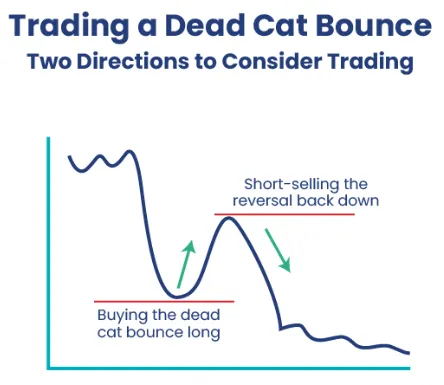
Visualized dead cat bounce. Source XS
What Actually Causes a Dead Cat Bounce
A dead cat bounce is not driven by improvements in a company's fundamentals or the broader economy. It is driven by market mechanics and human psychology. Understanding the forces behind it helps explain why the pattern is so common and so repeatable.
- Short covering - Traders who shorted the asset during the decline start buying shares to close their positions and lock in profits. This creates a temporary surge in demand that pushes the price up, even though the buying has nothing to do with bullish sentiment.
- Bargain hunting - Some investors see the lower price and assume the asset has bottomed out. They pile in, creating what amounts to fabricated demand based on an incorrect read of the situation.
- Emotional biases - FOMO pushes traders to buy because they are afraid of missing the bottom. Confirmation bias leads them to focus on bullish signals while ignoring bearish ones. Together, these psychological traps fuel the bounce and set the stage for further losses.
Risk management is the deciding factor. No one can identify a dead cat bounce with certainty in real time, so the traders who survive them are the ones who plan for being wrong.
Dead Cat Bounce vs. Real Recovery: A Side-by-Side Breakdown
One of the hardest skills in trading is distinguishing between a dead cat bounce and the start of a legitimate trend reversal. The table below outlines the key differences.
| Feature | Dead Cat Bounce | Recovery Rally/Trend |
| Trend Context | Occurs within a continuing downtrend | Marks the start of a long-term trend change |
| Duration | Brief, typically days to weeks | Longer-lasting, months or more |
| Fundamentals | No improvement in underlying outlook | Often supported by positive news or data |
| Volume Profile | Weak or inconsistent buying volume | Strong, sustained buying volume |
| Confirmation | Price breaks below the prior low | Price sets higher highs and breaks resistance |
The key takeaway from this comparison is that patience is often the best strategy. Waiting for confirmation through higher highs, sustained volume, and supportive fundamentals reduces the risk of buying into a false recovery.
Does the Dead Cat Bounce Show Up in Crypto?
Yes. The dead cat bounce pattern is not limited to traditional equities. It appears across asset classes, and cryptocurrency markets are no exception. Given that crypto assets tend to be more volatile than stocks, the bounces can be sharper and more deceptive.
That said, the underlying dynamics are the same: short covering, bargain hunting, and emotional trading all contribute to temporary price spikes within larger downtrends. Crypto traders should apply the same analytical framework, watching volume, resistance levels, and momentum indicators, to evaluate whether a bounce has real staying power.
Why This Pattern Still Matters for Every Market Cycle
The dead cat bounce has persisted as a market phenomenon for decades because it is rooted in human behavior rather than any specific market structure. As long as fear, greed, and cognitive biases influence trading decisions, this pattern will keep showing up.
For advanced traders and investors, the real lesson is not just about recognizing the pattern. It is about building a decision-making process that accounts for the uncertainty. Waiting for confirmation, using stop-losses, and separating technical signals from emotional impulses are the best defenses against getting trapped by a bounce that was never real to begin with.