


Zcash developers have targeted Nov. 5 for the NU7 mainnet upgrade after ecosystem engineering teams agreed on a package featuring 25-second blocks, version 4 transaction deactivation and a Network Sustainability Mechanism, with testnet activation planned for Oct. 6.
Sean Bowe said in a Sept. 17 community update that the Zcash Foundation, Project Tachyon, Valar Group, ZODL, Shielded Labs and the relevant engineering teams had reached “unanimous agreement” on the planned scope and timetable. The Nov. 5 date remains subject to a final Oct. 20 mainnet decision after developers review testnet behavior.
The current development schedule sets Sept. 30 as the feature-completion cutoff. Code intended for NU7 should be implemented and ready for inclusion in the testnet upgrade by that date, according to Bowe’s timeline.
Testnet activation follows on Oct. 6. Developers then plan to observe network behavior for two weeks before deciding the mainnet activation height on Oct. 20. The current Nov. 5 mainnet date would proceed only after that review.
The announced scope does not introduce a new transaction format. Bowe said wallets are not expected to require major changes from NU7 itself, while full nodes, indexers and block explorers may need adjustments to handle the new consensus rules.
The current Zcash ZIP repository still describes NU7 proposals as candidates and says the deployment ZIP will determine the final package. That repository has not yet replaced the draft deployment process with a finalized mainnet specification, so the Oct. 20 decision remains an important step before activation.
As previous governance coverage reported, the latest coinholder poll involved nearly 2.4 million ZEC, representing roughly 66% of the eligible Ironwood balances at the voting snapshot.
ZIP 218 proposes reducing Zcash’s target block spacing from 75 seconds to 25 seconds, which would produce roughly three times as many blocks over the same period. The proposal keeps daily ZEC issuance unchanged by reducing the subsidy paid per block to account for the faster schedule.
The draft says a first confirmation would arrive after an average target interval of 25 seconds instead of 75 seconds. Developers present the change as useful for payments, exchange deposits and cross-chain operations that currently wait for one or more block confirmations.
Faster blocks would come with new action limits. ZIP 218 sets a maximum of 330 actions across all pools per block, including no more than 330 Orchard actions, 300 combined Sapling inputs and outputs, and 25 Sprout JoinSplits.
The draft estimates that the configuration would lift Orchard throughput from roughly 2.9 transactions per second to 6.6 for two-action transactions. At the same time, its model reduces maximum shielded-wallet synchronization bandwidth under the specified denial-of-service scenario from 271 MB per day to 169 MB.
More blocks create extra overhead. ZIP 218 estimates wallets would download around 200 KB more compact-block header data per day. Full-node synchronization demand rises because three times as many blocks must be processed over a comparable period.
Testing examined the increased stale-block risk. The draft estimates a theoretical stale rate near 3.26% at 25-second spacing. A devnet with 99 geographically distributed Zebra nodes and 2 MB blocks produced a 4.86% stale-block rate and 0.37% fork rate during testing.
The proposal remains classified as Draft, meaning the technical specification can still change before final deployment.
The latest governance results rejected replacing Zcash’s existing halving schedule with the original issuance-smoothing proposal.
Coinholders representing 2,375,932.375 ZEC voted to preserve halvings, compared with 22,384.875 ZEC supporting a smooth issuance curve. The result gave the halving option roughly 98.9% of participating ZEC on that question.
For when ZEC removed through the Network Sustainability Mechanism should begin returning to circulation, 2,319,643.750 ZEC backed February 2031. Roughly 70,240 ZEC favored starting as soon as possible, while 6,283 ZEC selected February 2027.
Zcash Foundation, Project Tachyon, ZODL, Shielded Labs and Valar Group subsequently agreed to use February 2031, describing it as the most conservative reading of the mixed community polls. They said another vote could revisit that date later.
Bowe’s NU7 timeline therefore references an alternative NSM implementation that preserves halvings while allowing future reissuance to start in 2031. The ordinary ZIP 234 draft still describes smoothing the subsidy through an exponential-decay formula, so it should not be confused with the configuration selected after the September vote.
ZIP 235 specifies that at least 60% of transaction fees would be removed from circulation, with the remaining 40% available for miners. The removed ZEC is designed to return later through future block subsidies instead of being permanently destroyed.
The selected February 2031 timetable means fee-derived ZEC collected through the NSM could remain outside circulation for years before reissuance begins, assuming the planned rules survive final technical review.
NU7 is expected to disable version 4 transactions when the upgrade activates. ZIP 2003 states that v4 deactivation prevents Sprout funds from being spent because the newer v5 transaction format does not support the original Sprout shielded pool.
The proposal does not technically burn or unissue remaining Sprout balances. Its specification leaves open the possibility that developers could later restore a recovery mechanism, but no such future retrieval feature is promised.
Sprout has been largely unused for years. Zcash Foundation’s governance material said the pool held less than 23,000 ZEC and accounted for under 0.1% of transaction volume when the NU7 questions were put to voters.
Coinholders backed immediate v4 deactivation at NU7 in the September poll. The decision follows Zcash’s migration toward Sapling, Orchard and the newer Ironwood architecture, which became active with NU6.3 earlier in 2026.
Zebra’s current production releases already support NU6.3, while the Foundation has spent 2026 hardening node behavior ahead of later upgrades. Earlier Zebra releases widened the local rollback window from 99 to 1,000 blocks as a defense against prolonged consensus splits.
ZEC has risen sharply during the governance process, though the market move cannot be attributed solely to NU7.
CoinMarketCap data showed ZEC trading near $1,485 early Sept. 18, up roughly 9.6% over 24 hours, with trading volume above $2.6 billion. The token had already received other market catalysts during September, including institutional activity and the recent U.S.-listed Zcash investment product.
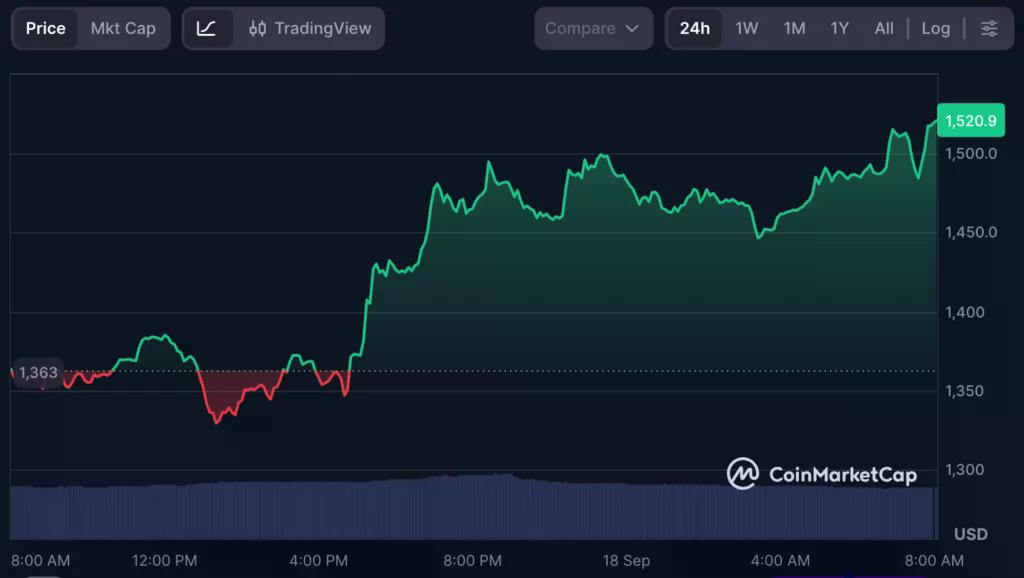
In recent ZEC market coverage, crypto.news reported that ZEC climbed more than 20% on Sept. 16 to around $1,337, with network-upgrade optimism cited alongside other trading factors.
Earlier in September, ZEC crossed $1,000 after Grayscale converted its Zcash Trust into the ZCSH exchange-traded product on NYSE Arca. Previous ETF coverage reported that the fund launched with roughly $304 million in assets before growing further as ZEC prices increased.
For NU7 itself, Sept. 30 is the next engineering checkpoint. Features not ready by that cutoff can be removed from the upgrade under the approach favored by coinholders, followed by the Oct. 6 testnet activation and the Oct. 20 mainnet decision.
The mainnet activation height has not yet been finalized. Developers plan to set it on Oct. 20 after reviewing the testnet upgrade, leaving Nov. 5 as the current scheduled date subject to that decision.






 ZEC
ZEC