

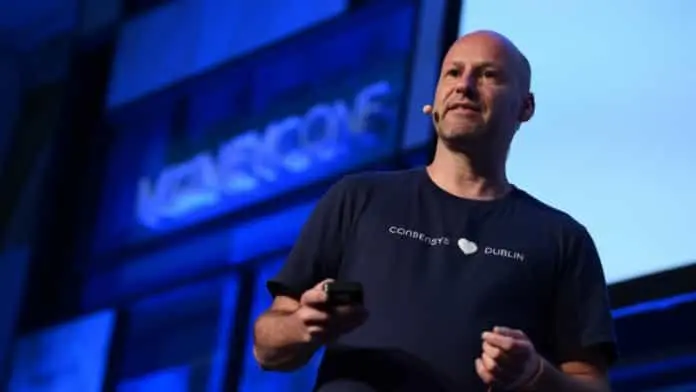
Consensys CEO Joseph Lubin argues that one way for the rollup-centric roadmap to succeed is to scale the Ethereum base layer.
"I'm a big fan of the rollup-centric roadmap," Lubin told The Block in an interview. "There are evolutions or innovations that are happening that are going to make the roadmap really powerful, or rollups really powerful."
This includes "beefing up the Layer 1" via initiatives like "Lean Ethereum," the long-term plan proposed by Ethereum Foundation researcher Justin Drake to simplify and strengthen the mainchain using cutting-edge zero-knowledge cryptography, and rolling out ZK proving.
He estimated that Ethereum could become a fully "zero-knowledge proof-based protocol" in 3 to 5 years, which would not only improve the base layer but also improve the composability between Ethereum and its Layer 2s.
Over the past several months, many of Ethereum’s key leaders have reevaluated the so-called rollup-centric roadmap, the plan targeted years ago to solve Ethereum’s scalability challenges through an ecosystem of semi-interconnected blockchains that all resolve down to the base layer.
Most notably, Ethereum creator Vitalik Buterin largely walked away from the rollup roadmap earlier this year, noting that the original vision had failed to play out and that most L2s had become, at best, "branded shards."
Instead, Buterin and the EF have recommitted to making Ethereum as cheap and fast to use as any rival blockchain, without sacrificing security or censorship-resistance. Layer 2s are still part of the roadmap, but only insofar as they add real value and are truly differentiated, like supporting major throughput and privacy innovations or non-EVM apps.
Lean Ethereum itself is aiming for over 10,000 transactions per second, while keeping the Ethereum mainnet's strong decentralization, and the EF has begun to support native privacy and quantum-resistant solutions.
For Lubin, Layer 2s are still a critical part of the Ethereum vision to create a World Computer, particularly as an environment to test out difficult technologies before they’re deployed on the mainnet.
"We always knew that zero-knowledge proofs were going to be significant in our ecosystem," Lubin said. "We thought they would be significant first at Layer 2. And we were right."
Lubin noted that Layer 2s are already achieving real-time ZK proving, with plans to bring this capability to Layer 1, and eventually transition Ethereum into a fully ZK-proof-based protocol supported by multiple formally verified provers.
Chains like Linea, developed at Consensys, and Gnosis, among others, are "making use of what zero-knowledge proofs enable to synchronously compose transactions across different networks," Lubin said.
In time, this work with real-time ZK proving could eventually support "a single atomic execution context" where users can begin to move assets across Ethereum-based networks without bridges, Lubin said. "You can unify fragmented liquidity that way."
Moreover, this unifying tech is also being extended to the private permissioned Besu networks, a fork of Ethereum developed by Consensys that’s used by institutions like Citi, DTC, and BNY Mellon, to potentially bring enterprise chains seamlessly into the broader Ethereum ecosystem, Lubin said.
Asked whether the rollup-centric roadmap needlessly delayed scaling or fractured Ethereum’s liquidity and user base, Lubin said: "It was intentional to seed pricing power to set Layer 2s up so that they can explore technology and flourish."
"We knew we were fragmenting liquidity. We knew that we needed a modular architecture where execution was done in a different place," he said, noting that both the web and traditional economy are "very big," and if they were to come onchain Ethereum would need infinite capacity.
"We're going to have essentially infinite capacity when all that stuff gets built out," Lubin said. "Some Layer 2 technologies will make it through and be systemically important, and it's good that we explored the solution space and found the right solutions."
While the previous phase of the rollup-centric roadmap could be called a "divergence phase," with optimistic rollups enabling quick market entry and ZK technology maturing, the ecosystem is now entering a "convergence phase" for composability.
To some extent, some of these dynamics are at play at the level of Ethereum governance. Onlookers have been particularly concerned by the spate of recent departures from the Ethereum Foundation.
Lubin shut down the idea that there may be a "second foundation," an idea that has been floating around for another non-profit steward of the Ethereum ecosystem to spring up to support the EF.
"There won't be a second foundation," Lubin said, adding that at least three groups will spin out of the EF to focus on core protocol work, usability and scalability, and institutional outreach. "The EF will focus on the CROPs components."
Disclaimer: The Block is an independent media outlet that delivers news, research, and data. As of November 2023, Foresight Ventures is a majority investor of The Block. Foresight Ventures invests in other companies in the crypto space. Crypto exchange Bitget is an anchor LP for Foresight Ventures. The Block continues to operate independently to deliver objective, impactful, and timely information about the crypto industry. Here are our current financial disclosures.
© 2026 The Block. All Rights Reserved. This article is provided for informational purposes only. It is not offered or intended to be used as legal, tax, investment, financial, or other advice.
