Why Google Stock Dropped After Its Best Year Ever
 Abdul Razzaq2026-02-22
Alphabet Inc. recently reported a blowout Q4 2025, pushing its full-year revenue past the $400 billion mark for the first time. Despite posting a record net profit of $132.17 billion for the year
The Real Reasons Behind the Selloff and Alphabet’s 2026–2030 AI Investment Thesis
When a company reports record revenue, expanding profits, and accelerating growth across nearly every business segment, investors normally expect celebration. Yet Alphabet Inc. surprised markets in early 2026 when its stock declined sharply despite delivering one of the strongest earnings reports in its history. Alphabet crossed $400 billion in annual revenue, beat analyst expectations across key metrics, and showcased rapid momentum in artificial intelligence and cloud computing. Still, shares fell more than 6% immediately after earnings. This apparent contradiction highlights an important truth about modern equity markets: stocks trade on future expectations, not past performance. Alphabet is no longer being valued as a mature advertising company.
Investors now see it as one of the central infrastructure builders of the AI economy. The recent selloff was therefore less about earnings quality and more about a single question dominating Wall Street: Can Alphabet turn massive AI spending into sustainable long-term profits? Understanding this shift is essential for evaluating Google stock’s outlook heading into 2026 and beyond.
Record Financial Performance: Alphabet’s Strongest Year Yet
Alphabet’s latest financial results reinforced its dominance across multiple technology sectors. During Q4 2025, revenue reached $113.83 billion, representing 18% year-over-year growth and comfortably exceeding consensus estimates. Diluted earnings per share climbed to $2.82, while net income surged nearly 30% to $34.46 billion. For the full year, Alphabet achieved a historic milestone, generating $402.84 billion in annual revenue alongside $132.17 billion in net profit, both all-time highs for the company. Growth was broad-based rather than concentrated in a single division. Google Search remained resilient, YouTube subscriptions expanded, and Google Cloud emerged as a major profit contributor rather than a speculative investment. CEO Sundar Pichai emphasized that AI integration across products, particularly through the Gemini model family, is reshaping how users search, create, and interact with digital services. On paper, the results looked flawless. Markets, however, focused on what comes next.
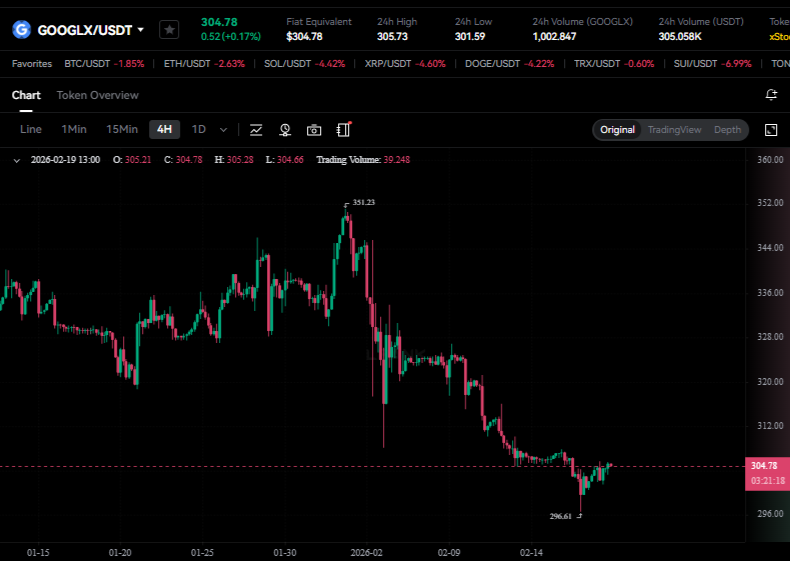
Why Google Stock Fell Despite Exceptional Earnings
The selloff was not triggered by weak business fundamentals. Instead, it reflected investor discomfort with Alphabet’s future capital allocation strategy. Alphabet announced projected 2026 capital expenditures between $175 billion and $185 billion, nearly doubling the previous year’s spending and significantly exceeding analyst expectations. This massive investment is primarily directed toward:
- AI data centers
- custom silicon and TPU chips
- cloud infrastructure expansion
- large-scale model training capacity
While strategically logical, such spending introduces short-term financial pressure. Heavy Capex reduces free cash flow, delays shareholder returns, and increases execution risk. In parallel, Alphabet slightly reduced share buybacks and maintained a stable dividend policy, signaling that management intends to prioritize long-term infrastructure dominance over near-term market appeasement. The market reaction was therefore rational: investors are not questioning Alphabet’s strength, but the timeline for AI monetization.
Alphabet’s Strategic Transformation: From Ad Giant to AI Infrastructure Company
For two decades, Google was fundamentally an advertising company powered by search dominance. That identity is rapidly changing. Alphabet is positioning itself as one of the core platforms underpinning the global AI economy, competing directly with Microsoft, Amazon, and emerging AI ecosystem leaders. This transition explains both the optimism and the uncertainty surrounding the stock.
Google Cloud: The New Growth Engine
The most significant structural change inside Alphabet is the rise of Google Cloud. Cloud revenue reached $17.66 billion in Q4, growing 48% year-over-year, while operating profits more than doubled to $5.31 billion. Even more important is the backlog of future contracts, which expanded to roughly $240 billion, signaling sustained enterprise demand. Companies worldwide are racing to integrate AI into workflows, and Google Cloud provides the computing backbone required for that transition. Unlike advertising revenue, which fluctuates with economic cycles, enterprise cloud contracts create predictable long-term income streams. If current growth rates persist, Google Cloud could evolve into Alphabet’s primary valuation driver by the late 2020s.
Advertising Business: Still the Cash Machine
Despite AI hype, advertising remains Alphabet’s financial foundation. Google Search generated over $63 billion in quarterly revenue, demonstrating remarkable resilience even amid competition from AI chat interfaces and short-form video platforms. Integration of Gemini AI into search results improved targeting efficiency and advertiser performance, offsetting competitive threats from platforms like OpenAI and TikTok. YouTube advertising growth slowed slightly, reflecting changing consumer attention patterns and tighter marketing budgets. However, subscription services such as YouTube Premium and Google One continue expanding recurring revenue streams, surpassing 325 million subscribers globally. The takeaway is clear: advertising may no longer define Alphabet’s future narrative, but it still finances its AI ambitions.
AI Scaling and Operational Efficiency
Alphabet’s AI strategy revolves around scale. The Gemini platform now processes billions of tokens per minute, serving hundreds of millions of monthly users. Crucially, Alphabet reported a 78% reduction in AI inference costs, demonstrating improving efficiency as infrastructure matures. At the same time, headcount growth slowed dramatically, signaling tighter operational discipline. Management appears focused on ensuring AI expansion does not permanently inflate operating expenses. This balance between aggressive investment and cost control will determine whether Alphabet maintains its historically strong margins.
The Real Investment Debate: Capex Today vs Profit Tomorrow
The market’s concern boils down to capital efficiency. Heavy infrastructure spending historically defines technological turning points. Similar skepticism surrounded Amazon during its early cloud expansion and Microsoft during its enterprise software transition. In both cases, short-term margin pressure ultimately enabled long-term dominance. Alphabet is attempting a similar transformation. Investors must decide whether current AI spending represents reckless overspending or a once-in-a-generation opportunity to secure technological leadership. The answer will depend on how quickly AI services generate measurable revenue streams. '
2026 Outlook: Key Drivers for Google Stock
Several variables will shape Alphabet’s stock performance over the next year. First, sustained cloud growth above 40% annually would validate management’s investment thesis. Second, maintaining strong search advertising margins will remain essential to funding AI expansion. Third, markets will closely monitor evidence that AI products translate into direct monetization rather than user growth alone. If Alphabet demonstrates clear returns on its infrastructure spending by late 2026, valuation multiples could expand again. Failure to show progress, however, may lead investors toward companies with faster cash-flow visibility.
Analyst Sentiment and Valuation Perspective
Alphabet currently trades near a premium earnings multiple relative to traditional technology firms. This valuation reflects investor belief that the company sits at the center of the next computing revolution. The bullish scenario assumes Alphabet becomes a dominant provider of AI infrastructure, enterprise tools, and intelligent search experiences. In that case, current price weakness may resemble past buying opportunities during earlier technology transitions. The bearish scenario focuses on execution risk. If AI competition intensifies or monetization timelines stretch longer than expected, valuation compression could continue despite strong revenues.
Long-Term Forecast: Alphabet Beyond 2030
Looking further ahead, Alphabet’s trajectory depends on whether AI becomes as economically transformative as mobile computing or cloud infrastructure once were. If successful, Alphabet could evolve into something closer to a digital utility provider powering global intelligence systems. Search, advertising, cloud, autonomous driving, and AI assistants would function as interconnected layers of a unified ecosystem. Few companies possess the data, infrastructure, engineering talent, and financial resources required to pursue such an ambition at scale.
Final Thoughts: Is Google Stock a Buy After the Drop?
Alphabet’s recent stock decline does not signal business weakness. Instead, it marks a transition phase where markets are recalibrating expectations around massive AI investment. For long-term investors comfortable with volatility, the selloff may represent an opportunity to gain exposure to one of the companies most deeply embedded in the future of artificial intelligence. For shorter-term traders, however, Google stock has entered a “proof period.” The company must now demonstrate that unprecedented spending translates into tangible profits. The next twelve months will likely determine whether Alphabet’s AI strategy becomes one of the greatest reinvention stories in tech history or a costly experiment that tested investor patience. Either way, Google stock is no longer just a search story. It is now a wager on the infrastructure of the AI era itself.
Disclaimer: Stock and futures trading involve significant risk of loss. The analysis provided is for informational purposes only and does not constitute financial advice. Always conduct your own thorough research (DYOR) and manage your risk exposure carefully.