Whale Withdraws 32,879 ETH (~$69M) from Kraken: A Quiet Shift Toward Self-Custody
 Premalynn2026-04-02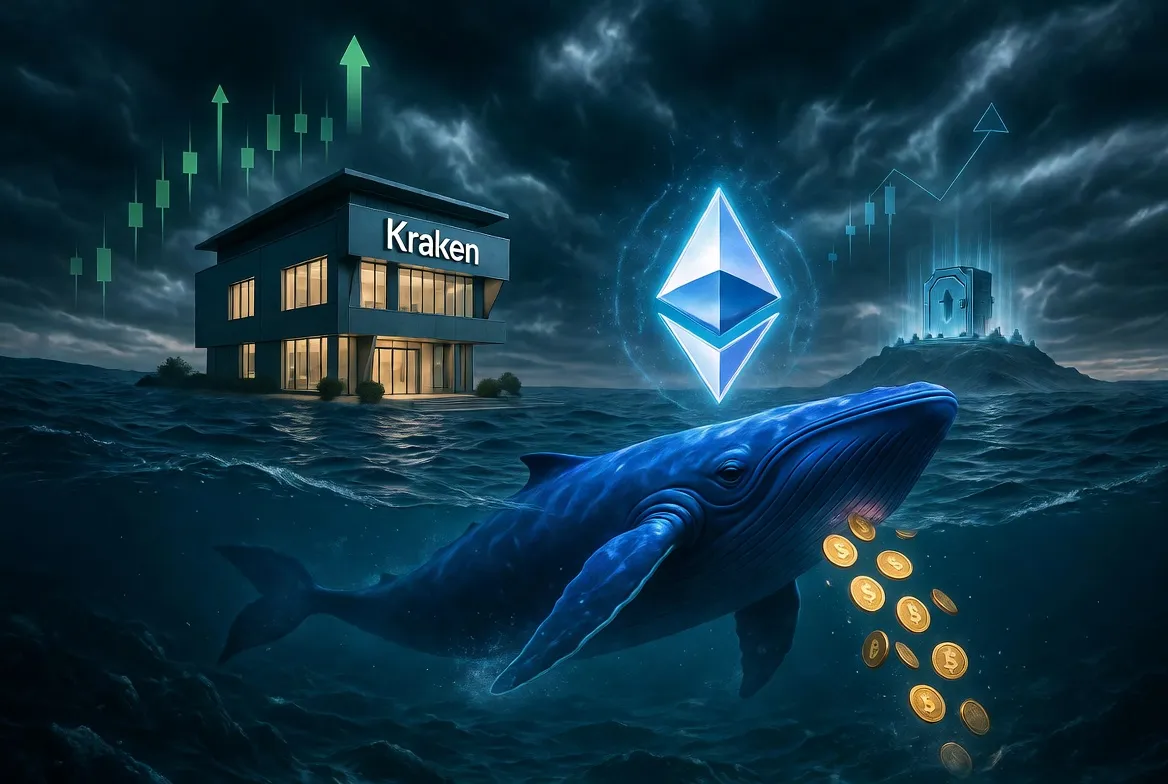
This article sheds light on a whale's withdrawal of 32,879 ETH ($69M) from Kraken, sparking questions on self-custody and long-term strategy.
A whale recently withdrew 32,879 ETH, worth around $69 million, from Kraken. In a market where every major move stimulates conjecture, this one stands out as proof that not all action is meaningless.
Large holders shifting assets off exchanges often tell a quieter story about confidence, strategy, or simple risk management.
What Actually Happened
On-chain trackers flagged the transaction recently. A single wallet, or cluster of wallets, swept the equivalent of tens of millions in ETH straight from Kraken's hot wallets into private custody.
At current prices hovering around $2,100 per ETH, the math checks out near that $69 million mark, give or take minor slippage or exact timing.
Whale withdrawals like this are not rare, but they always turn heads. Picture it like someone emptying a big checking account and moving the funds into a home safe.
The money does not vanish. It just changes hands, or rather, changes control. Centralized exchanges handle billions daily, yet when a notable chunk leaves, analysts pause.
Is this a vote of no confidence in the platform? A bet on long-term holding? Or preparation for something bigger, like staking, DeFi deployment, or even an over-the-counter deal?
Why Whales Move Assets Off Exchanges
Experienced observers know the usual playbook. Leaving funds on an exchange exposes them to counterparty risk, however small.
Hacks, regulatory freezes, and unexpected platform failures have all happened before, so switching to self-custody reduces that risk, even if it adds the task of managing private keys.
In Ethereum's case, off-exchange ETH often heads toward staking protocols or layer-2 solutions. With Ethereum's ecosystem maturing, holders might be positioning for yields or governance plays rather than quick trading flips.
Think of it as upgrading from a rental car to owning the vehicle outright: more control, potentially more upside, but you handle the maintenance.
Of course, the flip side exists. Some large moves precede selling pressure if the whale plans to liquidate elsewhere. Without clear wallet labeling, speculation fills the gap.
One day, the same address may accumulate quietly for months, and the next, it’s being redistributed across several wallets for security or privacy.
Patterns from previous cycles demonstrate that prolonged withdrawals during sideways or modestly bullish times are frequently associated with accumulation phases rather than dumps.
Broader Market Context
Ethereum has been navigating a complex stretch. Institutional interest via ETFs, upgrades to the network, and competition from faster chains all play into sentiment.
A single $69 million move represents real money, yet it pales in comparison to daily trading volumes that can reach billions of dollars. Even so, whales are important because their activities can have an impact on short-term liquidity and psychology.
Retail traders sometimes mirror these flows, chasing perceived smart money. That instinct can amplify volatility, turning a routine custody shift into a mini-narrative.
What's the healthiest approach? Treat it as one data point among many: financing rates, open interest, on-chain indicators such as exchange reserves, and macro signals all merit equal consideration.
Kraken itself remains a respected platform with strong security and regulatory footing. A withdrawal of this size does not signal trouble there.
If anything, it represents a mature market in which sophisticated players view exchanges as on- and off-ramps rather than long-term storage.
What It Might Mean for Traders and Holders
For those tracking the charts, such activity promotes contemplation rather than alarm. Has the exchange reserve data indicated a larger trend in the movement of ETH off the platforms? Are similar transactions occurring on other exchange platforms? Cross-referencing numerous trackers helps to distinguish signal from noise.
If you hold ETH yourself, this kind of news might prompt a quick security audit. Are your keys truly yours? Have you considered using hardware wallets or multisig setups for larger stacks? The whale's move exemplifies a timeless crypto truth: not your keys, not your currency.
At LBank, we see these large flows as part of the ecosystem's natural rhythm. They highlight why liquidity, security, and user control matter.
Whether you're scaling up positions or simply staying informed, keeping an eye on whale behavior adds depth to your market awareness without needing to react to every headline.
In the end, crypto rewards patience as much as timing. A $69 million withdrawal might spark debate today and fade into the data stream tomorrow.
What lingers is the reminder that behind these large numbers sit actual strategies, risk assessments, and the continuous evolution of the way in which value moves in this decentralized world.
Stay curious, verify the details, and trade accordingly. The next big move could be building quietly right now.