Why Self-Custody Still Matters: Hard Lessons from Recent Exchange Incidents
 Premalynn2026-04-03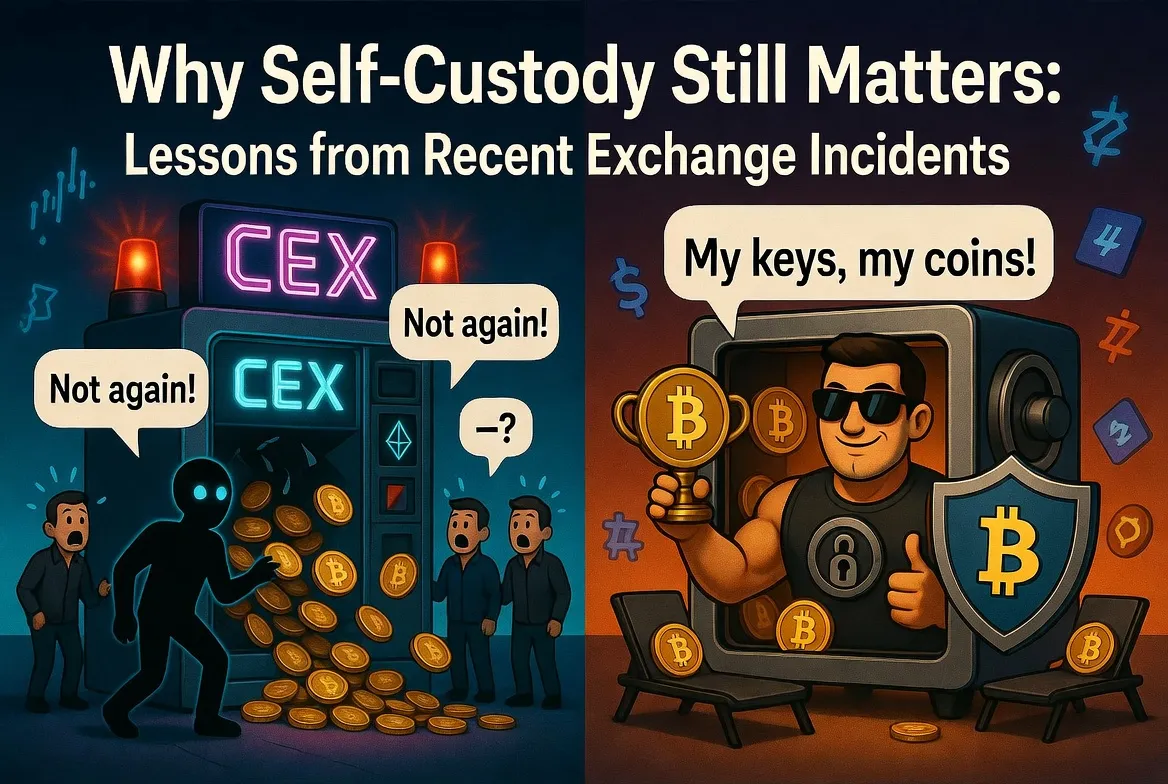
This article talks about the importance of self-custody in crypto, drawing important lessons from recent major exchange hacks and security incidents.
Crypto has always promised freedom, yet every time a major exchange stumbles, that promise gets tested in the harshest way possible.
The numbers from 2025 alone are sobering. Billions vanished in a handful of breaches, with one event dwarfing the rest.
It is not panic we need, but rather perspective. Self custody is not some radical fringe idea, it remains the clearest line between your assets and someone else’s problem.
The 2025 wake-up call
Early in the year, Bybit, one of the industry’s biggest players, suffered what many still call the largest single crypto theft in history.
Hackers made off with roughly $1.5 billion from a cold wallet. The details were murky at first, malware, compromised approvals, funds funneled out before anyone could react.
North Korean-linked actors were widely blamed. One incident, nearly half the year’s exchange-related losses.
It did not stop there, as Phemex lost tens of millions from hot wallets in January, and Iran’s Nobitex saw $90 million drained in a politically charged attack in June.
BtcTurk, CoinDCX, BigONE, and WOO X all took hits throughout the summer, each breach chipping away at user balances or operational funds.
Even decentralized protocols like Cetus on Sui bled $223 million in a single exploit. The pattern was unmistakable: whether the target was centralized or not, control over private keys proved to be the single point of failure.
These were not abstract losses, real people watched savings disappear overnight. Some recovered partial funds through insurance or goodwill gestures, but many did not.
The message landed differently this time because the hacks were bigger, the targets more established, and the excuses thinner.
Not your keys, not your coins—still true
The phrase has been around since the early days, almost a cliché now. But clichés earn their status for a reason.
When you leave assets on an exchange, you are essentially issuing an IOU to a company that promises to make good on your balance. Most of the time, they do, until they cannot.
Think about it like storing gold in a bank vault versus keeping it in a safe at home, the bank offers convenience, insurance policies, and fancy alarms, yet when the vault gets breached, every depositor feels the pain.
Self-custody flips the script, where using a self custody wallet to store your private keys which means your responsibility, and ultimately your control.
No middleman can freeze, seize, or accidentally lose what you alone hold.
Of course, this freedom comes with homework, as seed phrases must be guarded like family heirlooms, and hardware wallets need careful setup.
Mistakes here are permanent, but still, the trade-off feels fair when billions are vanishing from supposedly secure platforms.
What the breaches actually revealed
Most of the 2025 incidents shared a common thread: operational compromise rather than flashy smart-contract bugs.
Insiders, phishing campaigns, stolen API keys, and malware that tricked systems into approving massive withdrawals. Bybit’s cold wallet breach showed even offline storage is only as safe as the processes protecting it.
Hot wallets, the smaller slices kept online for daily liquidity, proved especially vulnerable. Several exchanges lost tens of millions precisely because these operational wallets held just enough to be worth targeting, meanwhile, user education lagged.
Many victims had enabled two-factor authentication, yet still fell to sophisticated social-engineering attacks that bypassed it.
The human element keeps surprising us. No amount of encryption stops someone from clicking the wrong link or trusting the wrong support message.
And once keys are compromised, speed is everything. Funds move across chains in seconds, laundered through mixers or instant swaps before anyone can freeze them.
Finding balance, not all-or-nothing
Self-custody does not mean swearing off exchanges entirely, as that would be impractical for trading, liquidity, or even simple on-ramps. Transitioning to self-custody wallets could be beneficial to you when you have no plans of trading.
The smarter path is hybrid. Keep what you need for daily activity on a reputable platform, and move the bulk, your long-term holdings, into cold storage.
Platforms like LBank illustrate this balance well, they maintain strong security practices, including substantial cold storage for user funds and standard protective features such as withdrawal whitelists and anti-phishing codes.
Start small, transfer a test amount to a hardware wallet, practice recovery, and learn multisig setups if your holdings justify the extra layer.
Tools have improved dramatically, and what once felt intimidating now fits in your pocket with clear interfaces.
Looking forward with clearer eyes
The industry will keep evolving, regulators will push for better standards, and exchanges will pour money into audits and insurance funds. None of that eliminates the core risk of trusting third parties with your keys.
Self-custody is not about distrusting every platform, it is about maturity. It is realizing that true financial sovereignty demands a little discomfort.
The recent incidents did not break crypto, rather, they reminded us why we entered this space in the first place: to step outside systems that could fail without warning.
Next time you see headlines about another breach, pause before the outrage fades. Ask yourself where your own assets actually sit, the answer might be more important than the price chart suggests.
In a world of growing hacks and sophisticated threats, holding your own keys is not paranoia. It is prudence, and in crypto, prudence still pays the best dividends.