A Deep Dive into Ethereum’s 2026 Glamsterdam Upgrade
 Abdul Razzaq2026-02-16
Following the Fusaka upgrade (late 2025), which successfully reduced L2 costs via increased blob capacity, Ethereum’s 2026 roadmap shifts focus back to the base layer (L1). The Glamsterdam upgrade.
Ethereum Glamsterdam Upgrade (2026):
Ethereum is entering a new phase of maturity. After years of scaling-focused upgrades that mostly helped Layer 2 networks, the roadmap is now shifting attention back to the base layer itself. Following the Fusaka upgrade in late 2025, the next major milestone is Ethereum Glamsterdam, expected in the first half of 2026. This upgrade is not about hype features or flashy headlines. It is about strengthening Ethereum’s foundations: how blocks are built, how validators interact with builders, how fees are priced, and how censorship resistance is enforced at the protocol level.
If Ethereum were a city, past upgrades focused on building highways around it. Glamsterdam focuses on fixing traffic lights, traffic rules, and governance inside the city itself. That might sound less exciting, but it is exactly what keeps a global financial settlement layer stable under pressure. For traders, DeFi users, and long-term investors, Glamsterdam quietly changes the cost structure, reliability, and fairness of Ethereum’s core engine.
What Is the Ethereum Glamsterdam Upgrade?
Glamsterdam is a coordinated hard fork that updates both of Ethereum’s main layers:
- The consensus layer, which handles validator coordination, block finality, and staking mechanics
- The execution layer, which runs transactions and smart contracts
Unlike earlier upgrades that focused heavily on rollups and data availability, Glamsterdam is explicitly Layer 1 first. Its goal is to make Ethereum’s base layer more efficient, more censorship-resistant, and less dependent on off-chain coordination. This matters because Ethereum’s decentralization promise depends on how independent validators and builders interact. If too much power sits with a few MEV relays or infrastructure providers, the network becomes fragile, even if it is technically decentralized on paper. Glamsterdam directly targets that risk.
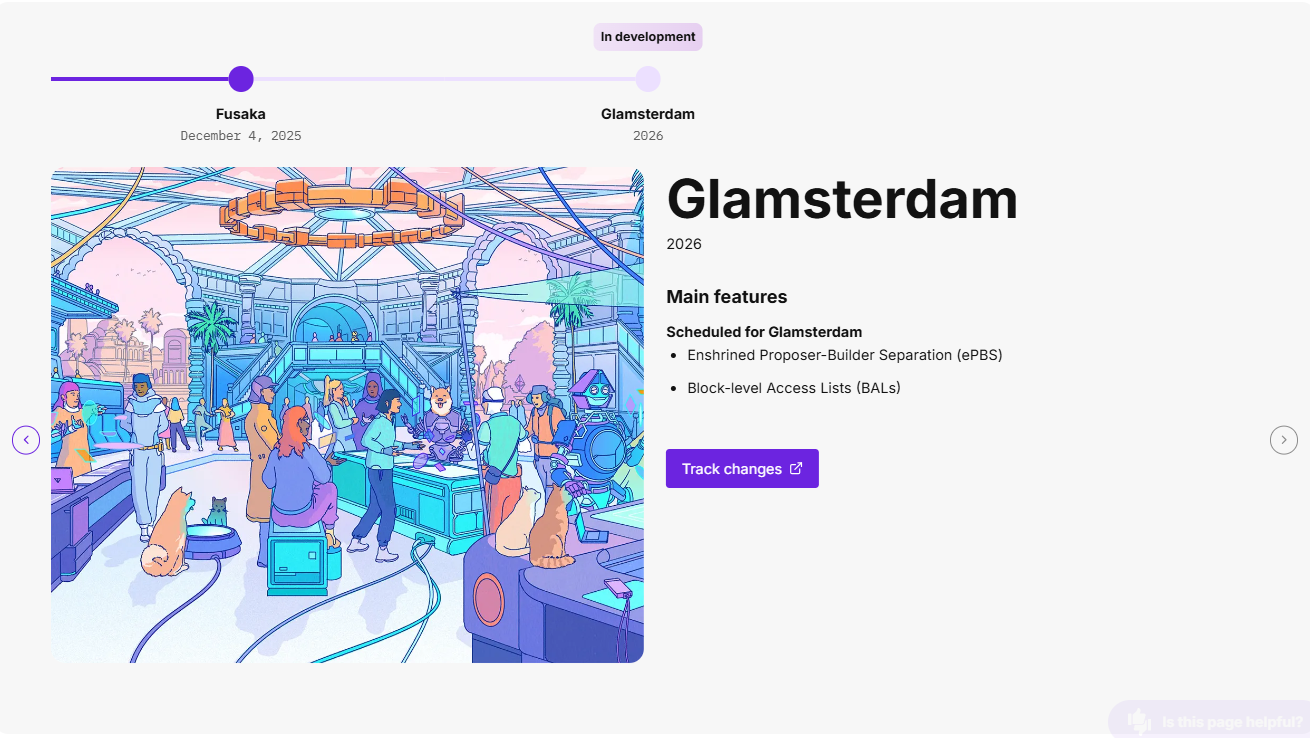
When Is Glamsterdam Expected to Launch?
Glamsterdam is currently planned for the first half of 2026. The exact date depends on how testnets perform and how stable the final client implementations are.
The rollout process follows Ethereum’s standard safety-first approach:
- Internal devnets first
- Public testnets next
- Mainnet activation only after stability is proven
This slow, deliberate rollout is why Ethereum upgrades rarely cause catastrophic failures. It is boring engineering. That is a feature, not a bug.
The Core Features: What Is Actually Changing?
1. Enshrined Proposer-Builder Separation (ePBS – EIP-7732)
Right now, Ethereum relies heavily on off-chain MEV relays to coordinate between:
- Proposers (validators who propose blocks)
- Builders (entities who assemble transaction bundles and extract MEV)
This system works, but it creates hidden power structures. Builders can censor transactions. Relays become trusted middlemen. Validators depend on off-chain infrastructure they do not control.
ePBS moves this entire relationship on-chain.
In simple terms, Ethereum is upgrading from a handshake agreement to a legally enforced contract between proposers and builders. The protocol itself enforces the separation and interaction rules.
Why this matters:
- Less censorship risk
- More transparent MEV flows
- Lower reliance on trusted intermediaries
- Healthier competition among builders
For traders, this reduces the risk of hidden transaction manipulation during volatile markets. For the network, it hardens Ethereum against centralization pressure.
2. Block-Level Access Lists (BALs – EIP-7928)
BALs require blocks to declare upfront which accounts and storage slots they will touch. This might sound technical, but the impact is very practical. Think of it like airport security. If passengers declare what they carry before arriving, security screening becomes faster and more predictable. If everyone shows up with mystery luggage, everything slows down.
BALs allow Ethereum clients to:
- Pre-load relevant state
- Validate blocks faster
- Prepare for future parallel execution
For DeFi protocols and high-frequency trading systems, this means:
- More predictable gas behavior
- Lower execution overhead
- Better performance during congestion
Over time, this improves Ethereum’s ability to handle bursts of activity without fee spikes getting totally out of control.
3.Gas Pricing Reforms
Ethereum’s gas pricing has accumulated years of weird incentives. Some actions are underpriced, others overpriced, and certain edge cases allow inefficiencies to persist.
Glamsterdam introduces a set of coordinated reforms that aim to align fees with real computational cost:
- Cheaper simple transfers
- Higher costs for state bloat
- More accurate pricing for heavy opcodes like hashing
- Fixes to refund exploits
- Calldata and access-list floors to prevent spam
The result is a fee market that behaves more like a rational marketplace and less like a set of legacy hacks layered over time.
For traders and active DeFi users, this means:
- Fewer fee surprises
- More predictable execution costs
- Less incentive for spam-driven congestion
4.Censorship Resistance
One of the quiet risks in MEV-heavy systems is censorship. Builders may exclude transactions they dislike or that conflict with their own positions. Proposals like FOCIL (Fork-Choice Enforced Inclusion Lists) aim to give validators protocol-level power to force the inclusion of specific transactions. This is Ethereum acknowledging a hard truth: Markets only work if participants can access the market. If transactions can be selectively excluded, Ethereum becomes a permissioned system in practice. Glamsterdam moves the protocol closer to enforcing neutrality at the base layer.
How Glamsterdam Builds on Past Upgrades
- Dencun (2024) made L2 transactions cheap
- Fusaka (2025) expanded blob capacity and lowered node costs
- Glamsterdam (2026) hardens block production and execution itself
This is a natural progression. Ethereum first scaled. Now it is stabilizing and professionalizing the core system that everything else depends on.
What Glamsterdam Means for Traders and DeFi Users
For traders and DeFi users, Glamsterdam is not a “new feature” upgrade. It is a market structure upgrade. Most traders only feel Ethereum at the surface level: gas fees, failed transactions, MEV frontruns, and weird execution during volatility. Glamsterdam quietly reshapes the mechanics behind those experiences. By bringing proposer–builder separation on-chain and reforming gas pricing, Ethereum reduces the number of invisible hands touching your transaction before it lands on-chain.
In practical terms, this means:
- More predictable execution during high volatility
- When markets move fast, the cost of failed or delayed transactions is real money. A more structured block-building process reduces chaos during liquidations, NFT mints, and sudden price moves.
- Lower long-term friction costs for active traders
- Over thousands of trades, small fee distortions add up. More rational gas pricing slowly shifts Ethereum from “expensive but necessary” toward “expensive but fair.”
- Cleaner DeFi execution paths
- Arbitrage, liquidations, and complex routing depend on timing and execution guarantees. Glamsterdam improves the reliability of those pipelines, which reduces tail-risk for DeFi users interacting with leveraged protocols.
If Ethereum is a trading venue, Glamsterdam is the upgrade that improves the matching engine and market rules, not the UI. You may not notice it on day one, but you will feel the difference over months of usage.
Developer Impact:
For builders, Glamsterdam is about reducing unknowns. Ethereum development has always involved designing around quirks: gas unpredictability, MEV uncertainty, block builder behavior, and execution variance. Glamsterdam does not eliminate complexity, but it replaces fragile assumptions with protocol-level guarantees.
This matters in three ways:
Cleaner mental models for application design
- When execution rules are more predictable, developers spend less time building defensive hacks and more time designing product logic. This improves security and developer velocity.
- Lower barrier for smaller teams and independent validators
- By reducing reliance on off-chain MEV infrastructure, Glamsterdam makes it easier for smaller operators to participate without being squeezed out by specialized relays and builder cartels.
- Better foundations for advanced execution models
- Block-level access lists and pricing reforms prepare Ethereum for more efficient execution patterns in the future, including partial parallelization and stateless client designs. This is not flashy now, but it compounds over time.
In short, Glamsterdam makes Ethereum less like a system you have to “outsmart” and more like a platform you can rely on. That reliability is what attracts serious teams and long-term capital.
What It Means for Other Protocols and Ecosystems
Ethereum does not exist in isolation. Changes to its base layer ripple outward across Layer 2s, DeFi protocols, bridges, and even competing chains.
Glamsterdam subtly shifts the competitive landscape:
Layer 2 networks inherit a stronger foundation
When Ethereum’s base layer becomes more reliable and censorship-resistant, rollups benefit indirectly. Their security assumptions improve, and settlement becomes more credible for institutional use cases.
DeFi protocols face less MEV-driven distortion
Cleaner block production reduces pathological behaviors like sandwich attacks and builder-side censorship. This makes protocol-level incentive design easier and reduces the need for constant MEV mitigation patches.
Other L1 chains feel competitive pressure
Many alternative chains market themselves on execution speed and fee predictability. Glamsterdam narrows that gap by improving Ethereum’s base efficiency without sacrificing decentralization. Over time, this forces competitors to differentiate on more than just “cheaper and faster.”
Infrastructure providers must adapt
MEV relays, block builders, and RPC providers will face a more regulated on-chain framework. This reduces opaque power concentration and pushes infrastructure toward more transparent service models.
Glamsterdam is Ethereum quietly raising the bar for what “serious blockchain infrastructure” looks like.
What Comes After Glamsterdam?
Glamsterdam is not the end of Ethereum’s roadmap. It is a structural checkpoint.
The next major phase, often referred to as Hegota (targeted for late 2026), shifts focus toward long-term data management and node sustainability. While Glamsterdam fixes how blocks are produced and priced, Hegota addresses how Ethereum handles history, storage growth, and archival data. Think of it like this: Glamsterdam upgrades the engine and transmission. Hegota upgrades the fuel tank and maintenance system together, they move Ethereum toward a future where: Nodes are cheaper to run, Historical data is more manageable, Long-term decentralization becomes economically sustainable. This matters because a chain that scales but becomes too expensive to validate eventually centralizes. Ethereum is explicitly designing against that failure mode.
Final Thoughts: Why Glamsterdam Matters More Than It Looks
Glamsterdam is not built for headlines. It is built for stress. Most protocol failures do not happen during calm markets. They happen during panic, liquidations, political pressure, censorship events, and infrastructure outages. Glamsterdam is Ethereum preparing for those moments before they arrive.
It strengthens three pillars that matter more than hype: Fairness in how blocks are built, Neutrality in which transactions get included and Sustainability in how costs are priced over time. This is Ethereum acting less like an experiment and more like a financial settlement layer that expects to be attacked, regulated, overloaded, and scrutinized by the real world.
If you believe Ethereum is meant to support global finance, not just crypto-native games, Glamsterdam is a quiet but serious step in that direction.
Conclusion
Ethereum Glamsterdam is not a hype upgrade. It is a maturity upgrade. It strengthens the base layer, improves fairness in block production, fixes fee distortions, and prepares Ethereum for long-term scalability without sacrificing decentralization. For traders, builders, and long-term investors, Glamsterdam is the kind of upgrade you want quietly working in the background while markets do what markets do. If you care about Ethereum as more than just a short-term trade, Glamsterdam is a signal that the protocol is growing up.
Disclaimer: Cryptocurrency investments and technical upgrades involve significant risk. Always conduct your own thorough research (DYOR) and manage your risk exposure carefully.