Decentralized Perp DEX Volumes Drop 49% From Peak
 jo****@gmail.com2026-04-18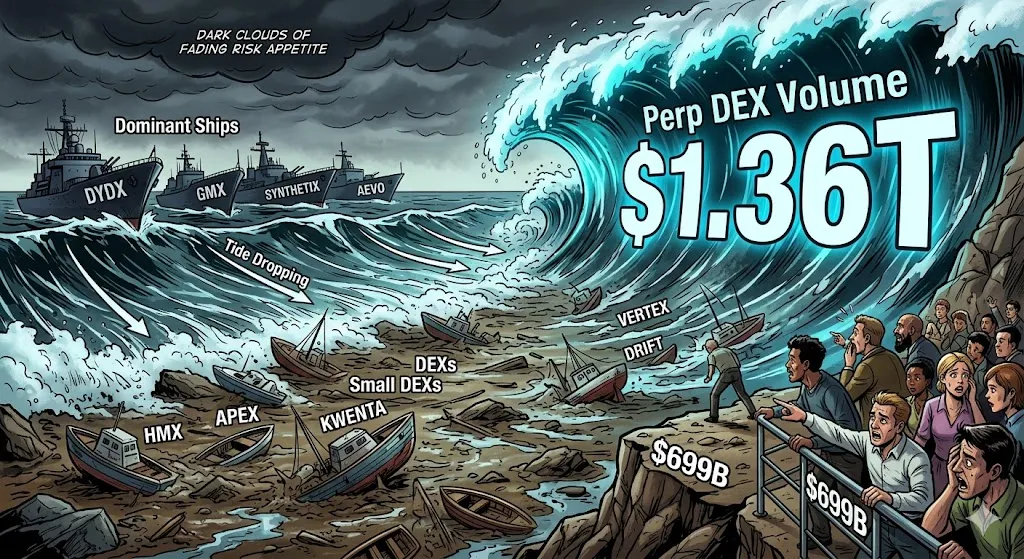
Perp DEX volumes dropped 49% from Oct 2025's $1.36T peak to $699B in March 2026, with daily volume hitting a 9-month low. Hyperliquid holds ~33% market share amid security and regulatory headwinds.
For the fifth consecutive month, on-chain Perpetual futures trading volumes fell from their peak volume of October 2025. Based on the numbers, it's hard to argue that what we have seen is a temporary change ─ we see that Perp volumes on Decentralized Exchanges (DEXs) as of March 2026 have dropped from their peak volume of $1.36 Trillion in October 2025 to $699 Billion, as per DefiLlama's data. The decline continued through November 2025 and December 2025, resulting in lower volumes through Q1 2026.
That's a nearly 49% decline over a period of approximately 5 months. In a market where multi-billion dollar price movements within a single day occur without raising an eyebrow, the sustained decline over this period of time at the sector level should raise red flags among investors.

Perpetuals DEX monthly trading volumes. Source: DefiLlama
From Trillion-Dollar Months to a Long Slide Down
To assess current conditions of the market, it may be beneficial to analyze previous cycles. In 2025, cumulative volumes for perpetual DEXsincreased nearly threefold compared to 2022, reaching $12.09 trillion, with approximately $7.9 trillion of that volume occurring in 2025 alone; $1 trillion per month had been generated by the end of Q4 2025 and averaged close to that level for all of 2025.
Such explosive volume growth occurs only under certain circumstances: the underlying crypto price increases; investor demand for risk is heightened; and there have been an increase in the number of traders willing to trade on the blockchain for the purpose of taking leveraged positions. Each of these conditions have been softened as we move further into 2026.
The decline is similar to previous periods in which crypto derivatives markets experienced high levels of risk-taking in times of upward price movement and eventually transitioned into periods of consolidation as the market works out leverage, investor funds and liquidity transition between trading venues. Although this presents an accurate account for the reason behind the recent five month down move in perpetual DEX volumes, it misses one major detail: the five-month period of time during which perpetual DEX volumes declined was not comprised of an abrupt return to stable, but rather was a protracted, gradual, multi-month trend across all relevant time frames without the occurrence of any price reversals.
Daily Volume Hit a Nine-Month Low in April
While the monthly data is sobering, the daily data is staggering. The day after April 4th, per perp DEX volumes fell to $8.4 billion for the first time since September 6, 2025, and the lowest since July 5, 2025.
To give perspective, a couple of years ago, $8.4 billion would have been a substantial daily volume. Prior to that, daily volumes were frequently below $4 billion; thus, we can conclude that the perp DEX marketplace has seen growth in this time period, but this growth was not consistent. Simply put, the perp DEX marketplace is not collapsing back to levels seen in 2023. Instead, it is simply backing off from an unsustainable peak that likely would never have existed even in the best-case scenario.
Hyperliquid Still Owns a Third of All Volume
A key indicator for this slowdown can actually be found not only in how much has been traded but where those trades happened. In total, Hyperliquid reported around $185.5B of trading in the last 30 days, which represents about 33% of the trading in the top 10 perp DEXs.
There is a massive gap between Hyperliquid and the next largest competitors, with EdgeX reporting approximately $73B in volume and Aster reporting approximately $68B. This shows the significant distance both in terms of volume and relative market position between Hyperliquid and other major protocols.
Here's the monthly volume breakdown across the decline:
To entice traders and create liquidity in their DEXs (decenotypes) several blockchain platforms have raced to launch and host DEXs but historically the vast majority have flowed through just a handful of dominant platforms, not spread evenly across a wide variety of venues. We see a clear example of this dynamic occurring at the present moment. When the tide is low, it does not raise all boats — the tide exposes which DEX platforms have loyal users and which platforms were simply benefiting from the tide of other DEX's growth.
Is This a Cycle or a Structural Problem?
Should perp DEXs see a quick resurgence in popularity following many recent sharp price movements, this would indicate that the recent downturn in trading activity is not a permanent shift, but rather an example of an up-and-down cycle. If volume does not bounce back even in environments where there is a great deal of price volatility, then it will demonstrate that traders who engaged in trading on-chain derivatives previously have totally lost interest, or have moved entirely to centralized exchanges.
There are, however, some genuine underlying issues that must be recognised. Most liquidity providers have become very hesitant to allocate funds to on-chain derivatives exchanges/venues, due in part to the number of recent high-profile incidents where oracles have been manipulated & protocols have been hacked/malfunctioned, resulting in decreased trust in on-chain derivatives & their venues. The Drift Protocol $285M exploit is a stark recent example. Additionally, the continued regulatory uncertainty in the US regarding how to appropriately regulate crypto trading has left many institutional traders sitting on the sidelines with capital that was intended to be used to assist perp DEXs with becoming a longer-term viable trading venue.
All of these issues represent obstacles for perp DEXs; however, they will not end the longevity of perp DEXs as we know them today. Perp DEXs are rather complex within themselves, so with respect to using a "just wait for the next bull run" logic if/when trying to determine whether or not to continue investing time and/or capital in on-chain derivatives trading.
The perp DEX space built something real in 2025. Monthly volumes measured in trillions, user bases that stretched beyond crypto natives, and infrastructure that could genuinely compete with centralized exchanges on execution quality. The five-month decline doesn't undo that. But it does mean the next chapter has to be written with fewer tailwinds. Whether platforms like Hyperliquid can maintain dominance while the broader market finds its footing — and whether smaller competitors can survive long enough to compete in a recovery — will define what the onchain derivatives space actually becomes.